Function to generate empirical unidimensional item and test plots
Source:R/empirical_plot.R
empirical_plot.RdGiven a dataset containing item responses this function will construct empirical graphics using the observed responses, potentially conditioned on the (reduced) total/composite score. When individual item plots are requested then the total score will be formed without the item of interest (i.e., the total score without that item).
Usage
empirical_plot(
  data,
  which.items = NULL,
  type = "prop",
  smooth = FALSE,
  sort = FALSE,
  formula = resp ~ s(TS, k = 5),
  org.data = NULL,
  ts_fun = rowSums,
  discrim.cut = 0.2,
  main = NULL,
  par.strip.text = list(cex = 0.7),
  par.settings = list(strip.background = list(col = "#9ECAE1"), strip.border = list(col =
    "black")),
  auto.key = list(space = "right", points = FALSE, lines = TRUE),
  ...
)
Arguments
- data
a
data.frameormatrixof item responses (seemirtfor typical input)- which.items
a numeric vector indicating which items to plot in a faceted image plot. If NULL then empirical test plots will be constructed instead
- type
character vector specifying type of plot to draw, some of which change as a function of the
which.iteminput.- 'prop' (default)
cumulative total-score proportions. If
which.itemsspecified then item-level conditional proportions are instead plotted against the reduced total scores- 'hist'
histogram of total scores
- 'bar'
barplot of total scores
- 'freq'
item response frequencies (supports
which.item)- 'discrim'
reduced item-total correlations to visualize discrimination effects
- 'difficulty'
mean/proportion of each item
- 'discrim_diff'
reduced item-total correlation against item difficulty
- 'alpha_rm'
effect on coefficient alpha if item were removed
- 'boxplot'
conditional boxplots of reduced total scores (supports
which.items)- 'bubble'
bivariate frequency bubble plots (requires that
which.itemsis exactly of length two)
- smooth
logical; include a GAM smoother instead of the raw proportions? Default is FALSE
- sort
logical; when applicable, sort the items first (e.g., in discrimination plot)?
- formula
formula used for the GAM smoother
- org.data
identical to
data, but contains the "unscored" response options (e.g., the original coding in a multiple-choice test). Used in various item-level plots for diagnostic purposes, such as in distractor analyses. This will also automatically add size and linetype changes to highlight the detected scored categories- ts_fun
similar to the same argument in
itemstats- discrim.cut
horizontal cut-off line to use when
type = 'discrim'. Default is .2 (to omit, useNA)- main
the main title for the plot. If NULL an internal default will be used
- par.strip.text
plotting argument passed to
lattice- par.settings
plotting argument passed to
lattice- auto.key
plotting argument passed to
lattice- ...
Details
Note that some of these plot types should only be used for unidimensional tests with monotonically increasing item response functions. If monotonicity is not true for all items, however, then these plots may serve as a visual diagnostic tool so long as the majority of items are indeed monotonic.
References
Chalmers, R. P. (2012). mirt: A Multidimensional Item Response Theory Package for the R Environment. Journal of Statistical Software, 48(6), 1-29. doi:10.18637/jss.v048.i06
Examples
# \donttest{
SAT12[SAT12 == 8] <- NA
data <- key2binary(SAT12,
key = c(1,4,5,2,3,1,2,1,3,1,2,4,2,1,5,3,4,4,1,4,3,3,4,1,3,5,1,3,1,5,4,5))
# test plot
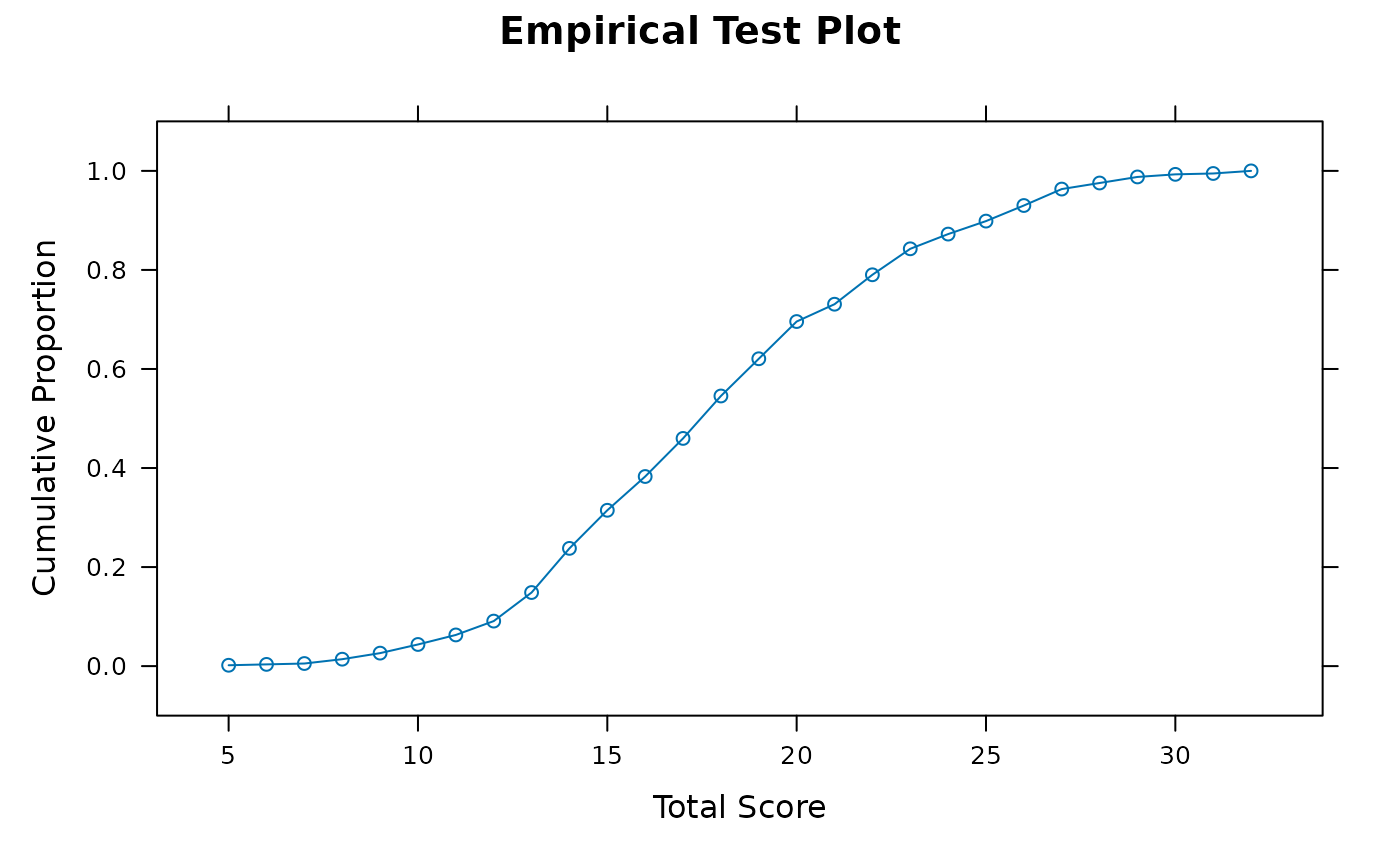
empirical_plot(data)
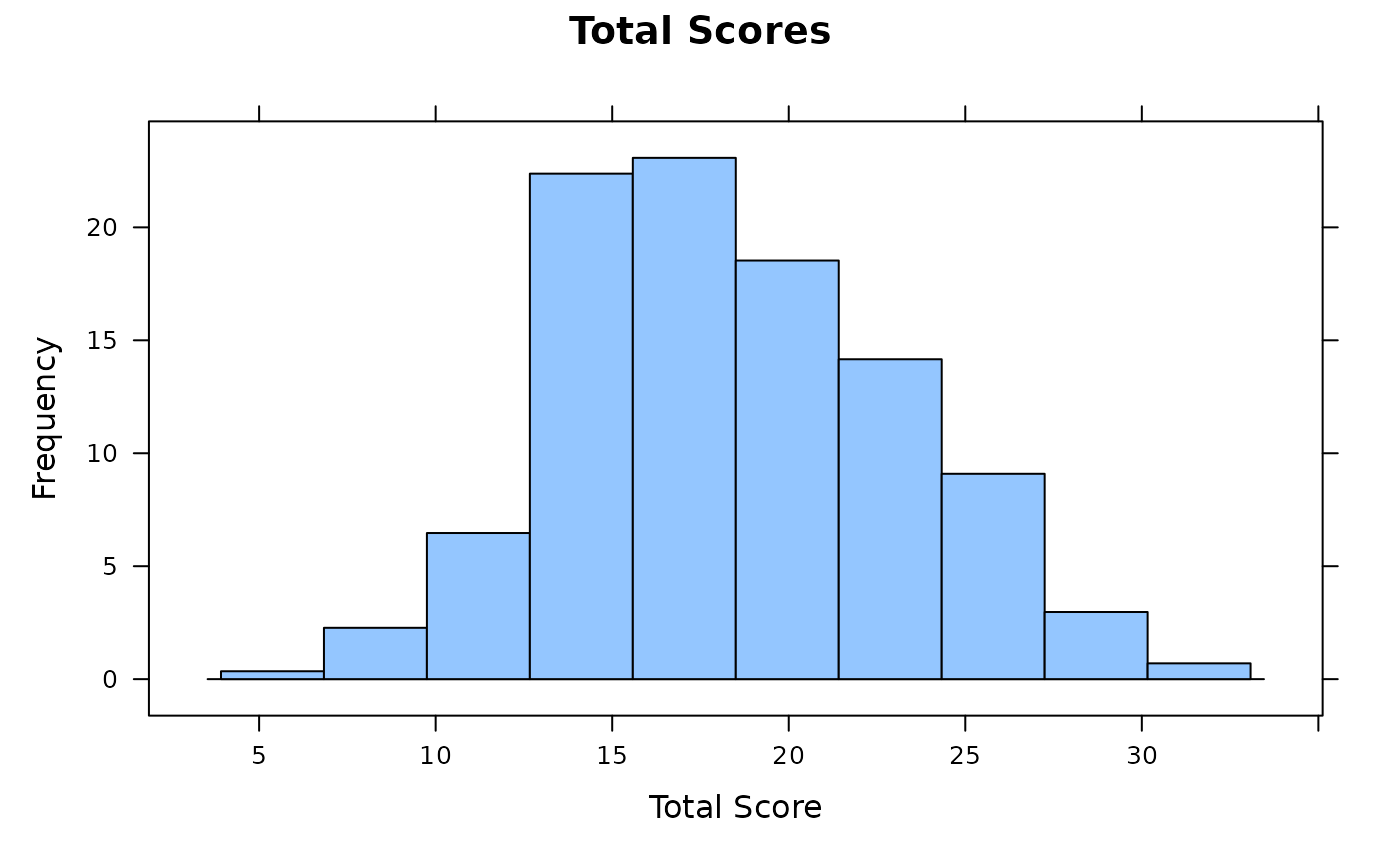
 empirical_plot(data, type = 'hist')
 empirical_plot(data, type = 'hist', ts_fun=rowMeans)
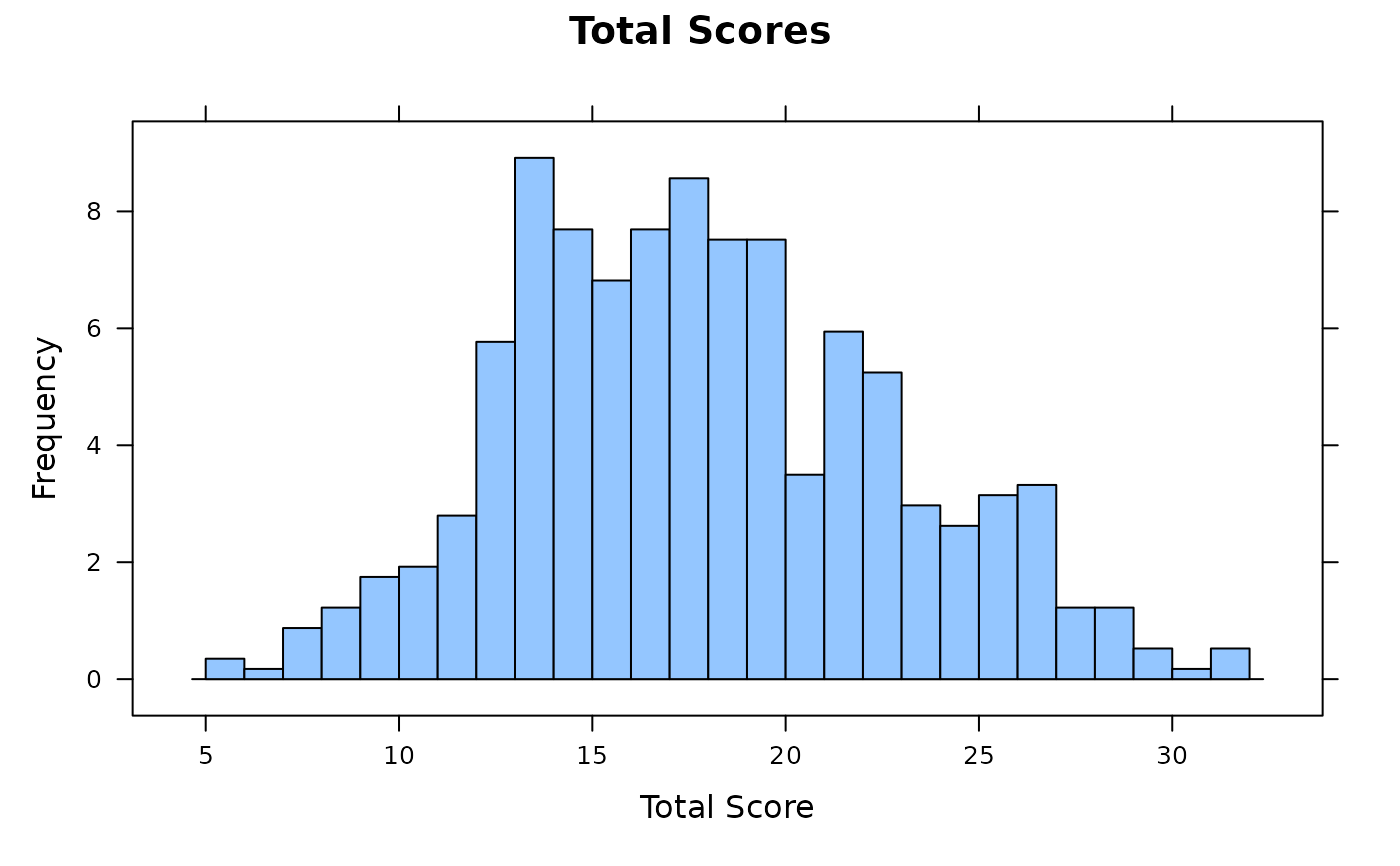 empirical_plot(data, type = 'hist', breaks=20)
 empirical_plot(data, type = 'bar')
 empirical_plot(data, type = 'discrim')
 empirical_plot(data, type = 'discrim', sort=TRUE)
 empirical_plot(data, type = 'difficulty')
 empirical_plot(data, type = 'difficulty', sort=TRUE)
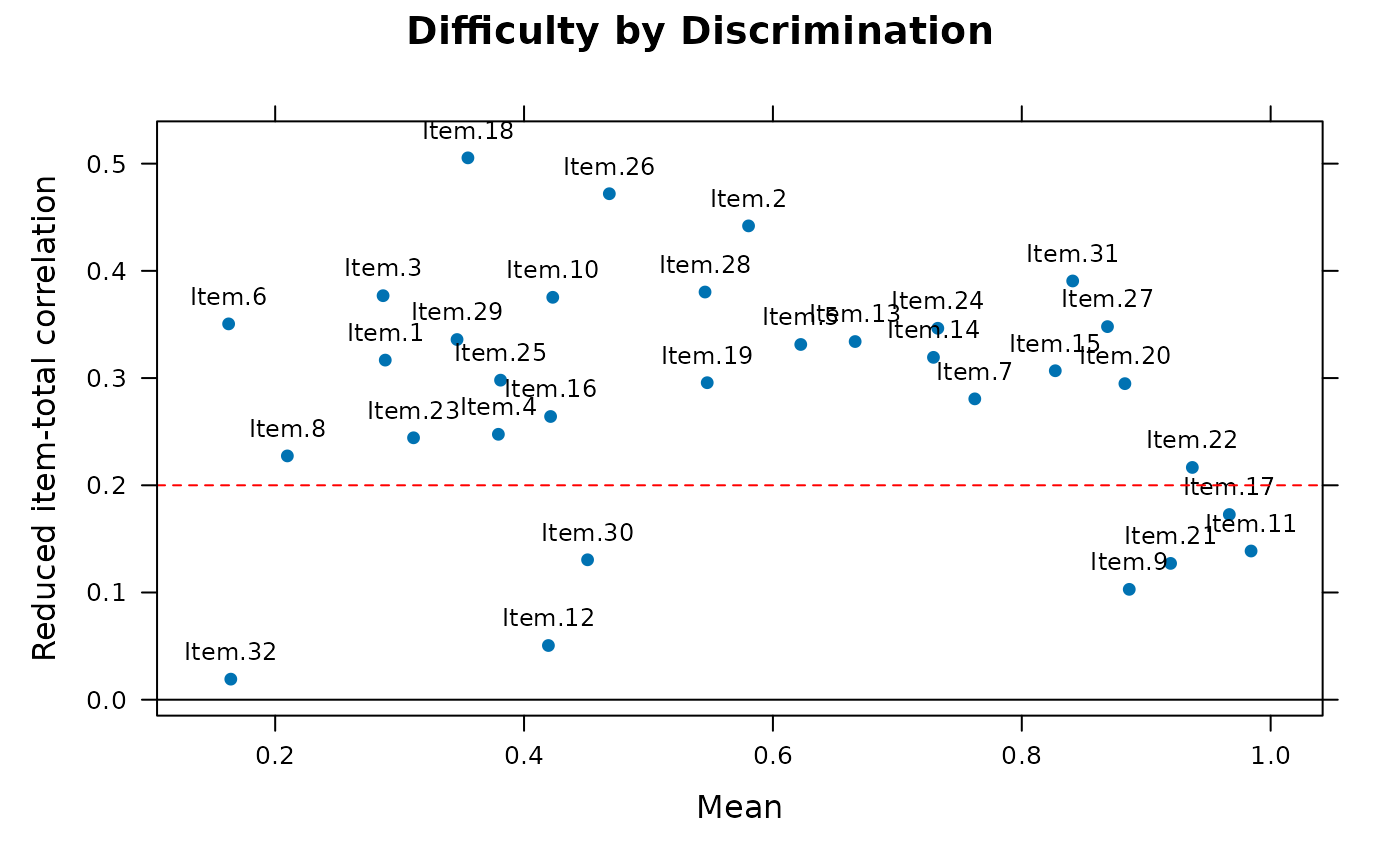
 empirical_plot(data, type = 'discrim_diff')
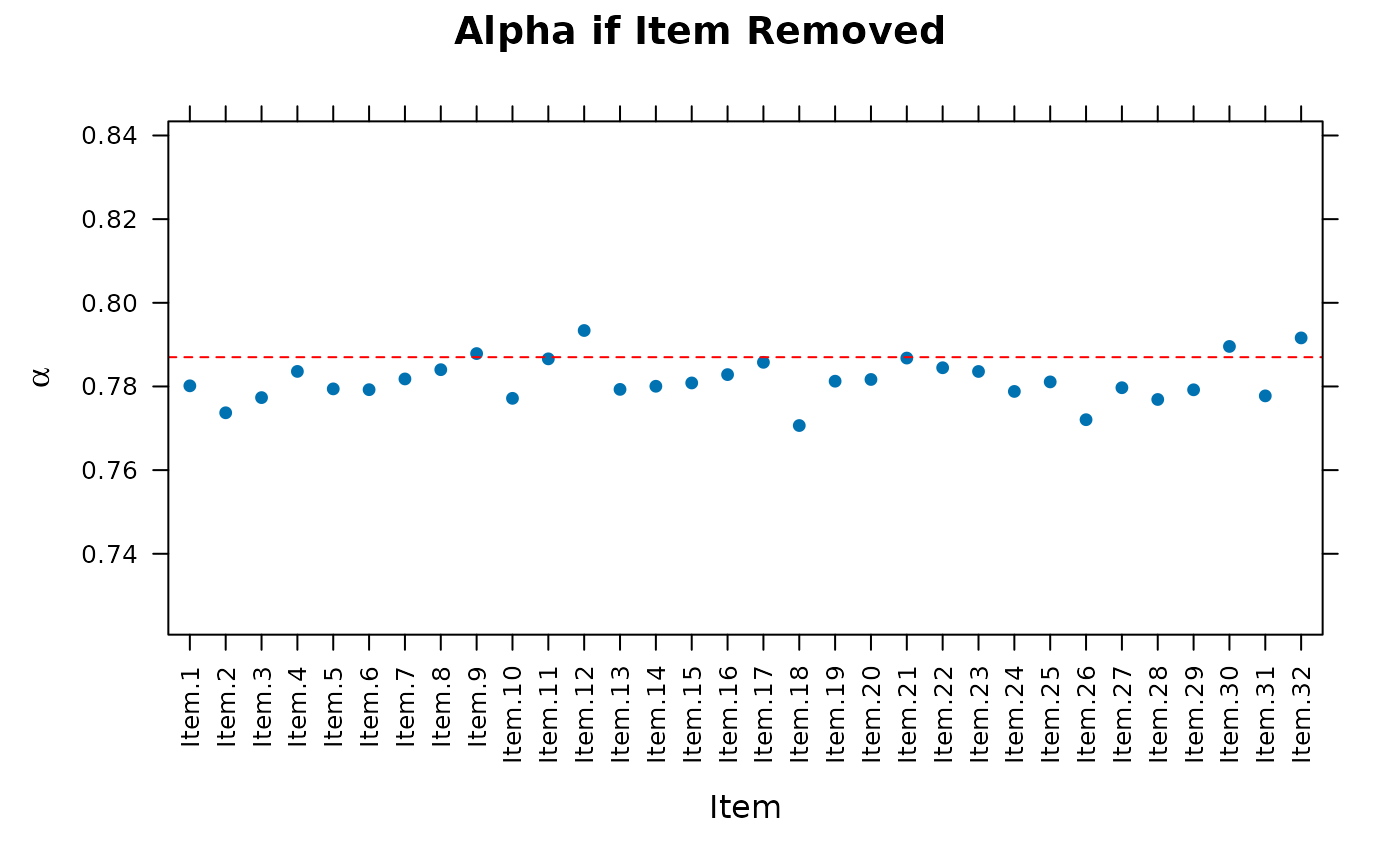
 empirical_plot(data, type = 'alpha_rm')
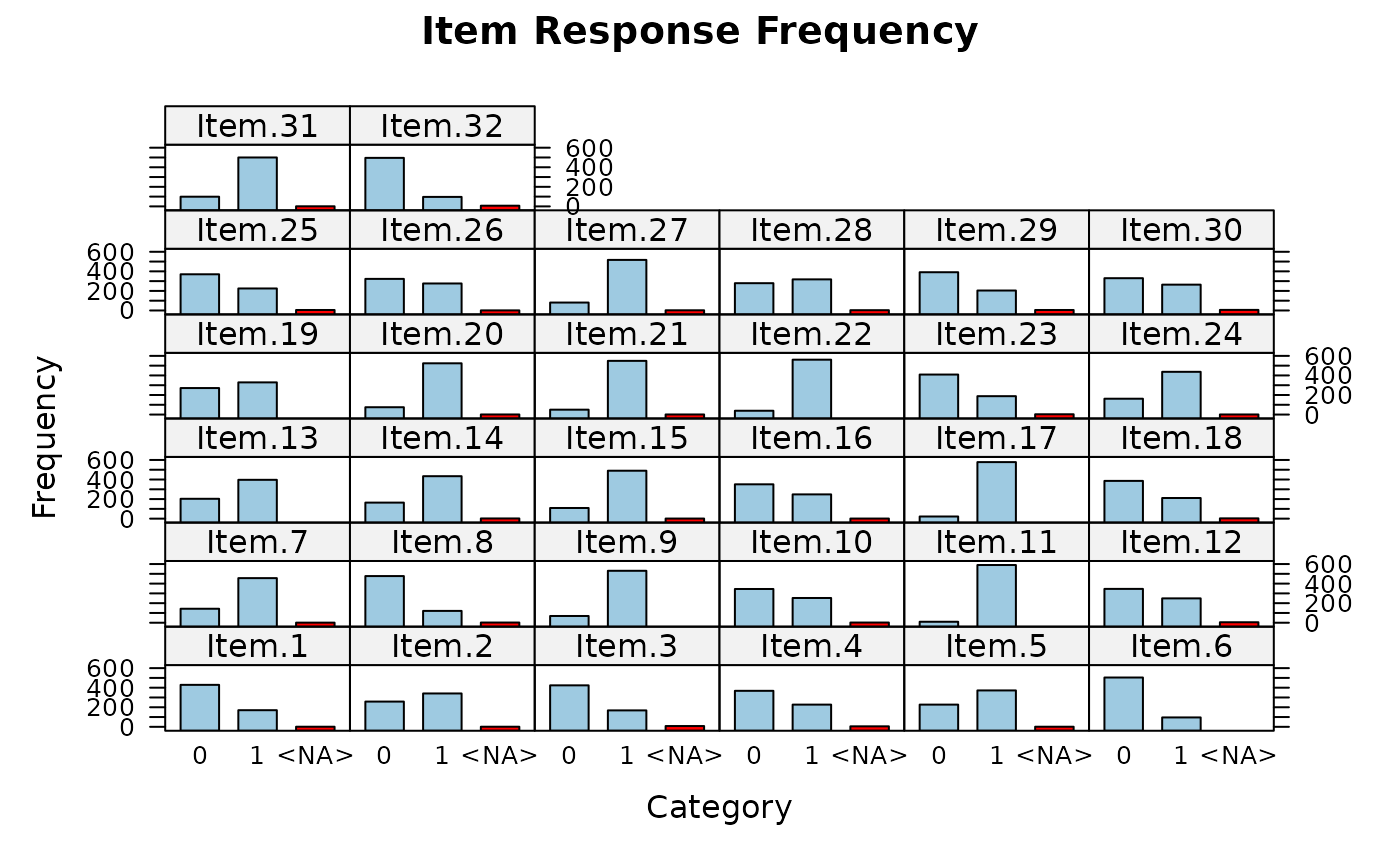
 empirical_plot(data, type = 'freq')
 # items 1, 2 and 5
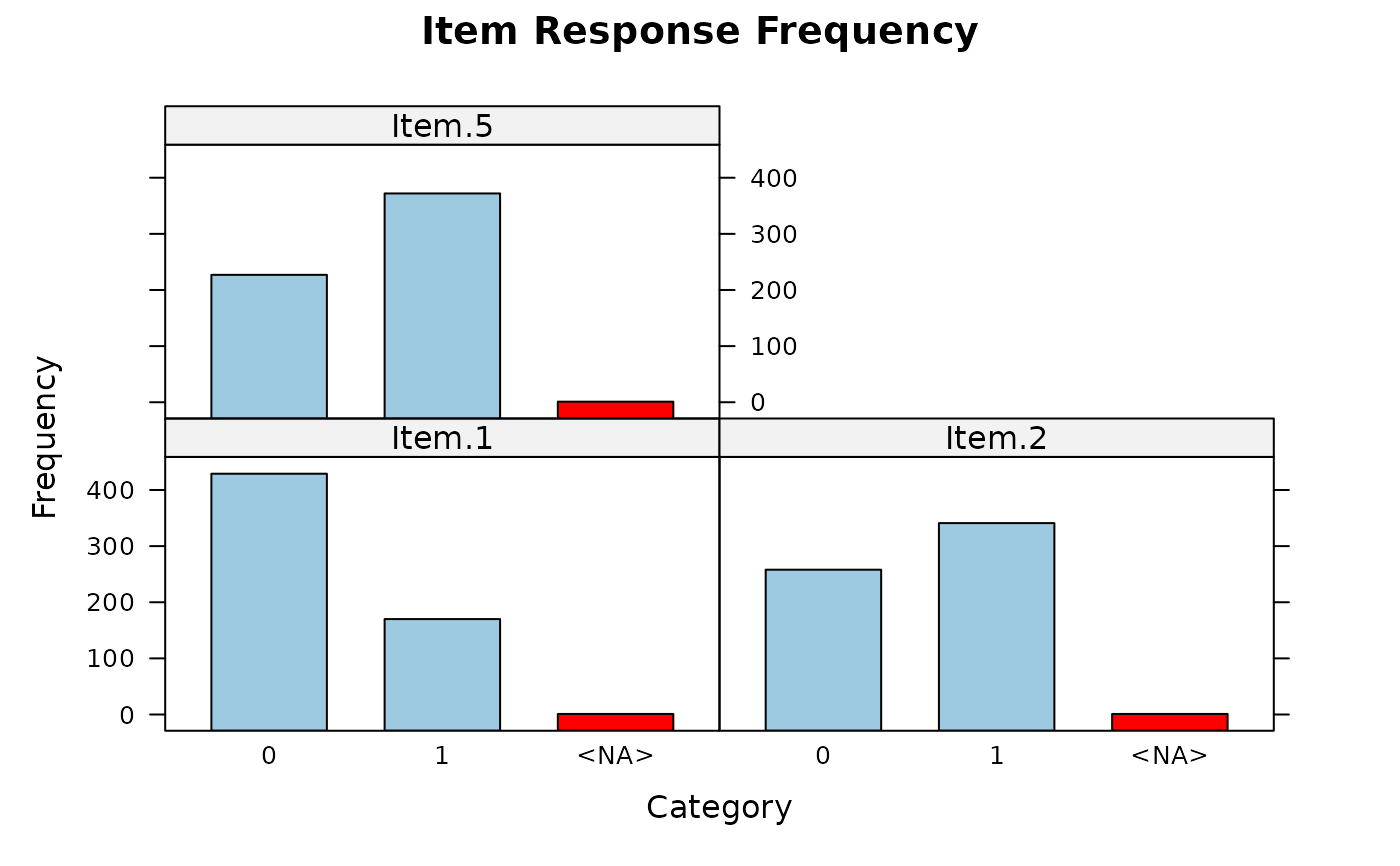
empirical_plot(data, c(1, 2, 5), type = 'freq')
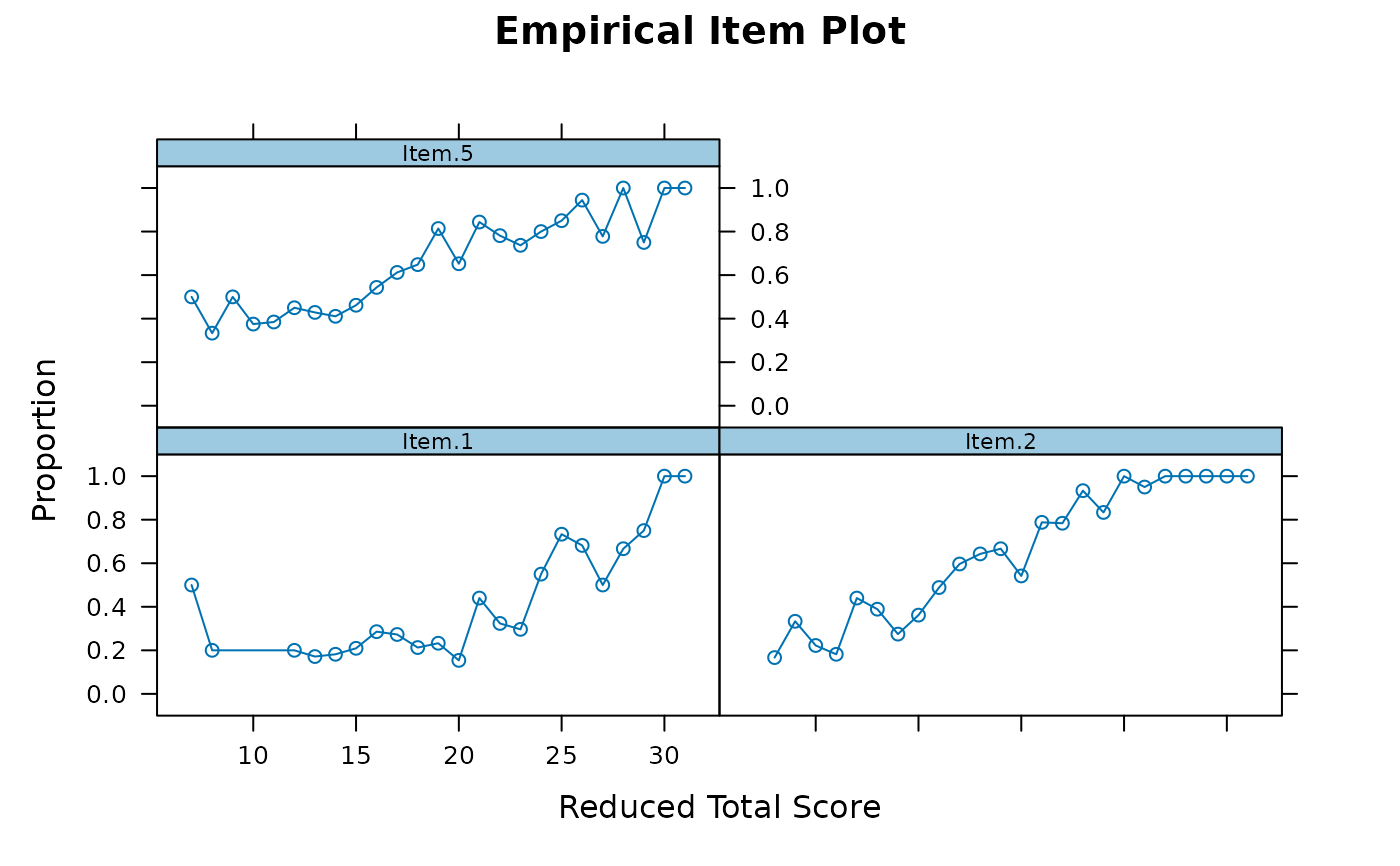
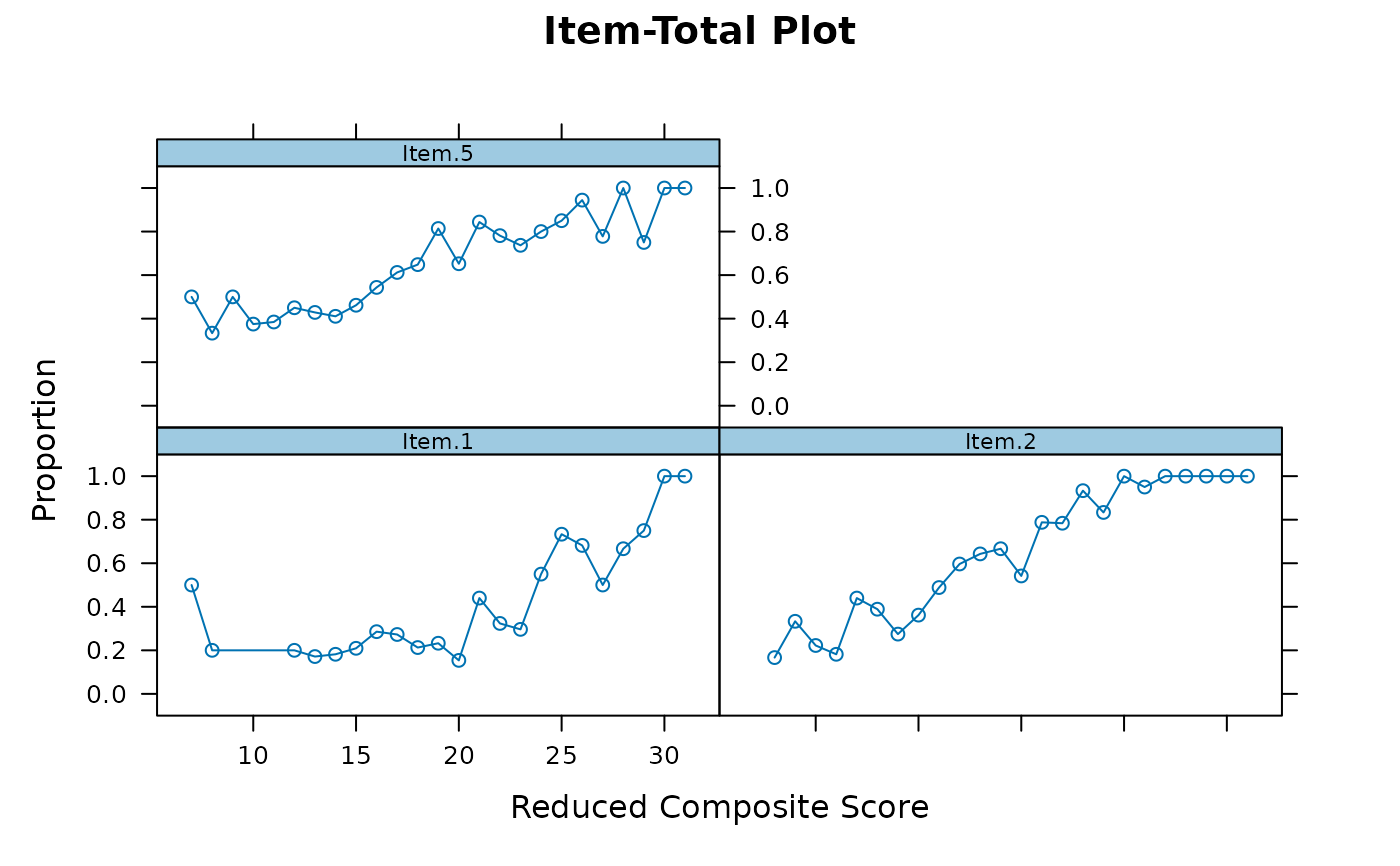
 empirical_plot(data, c(1, 2, 5))
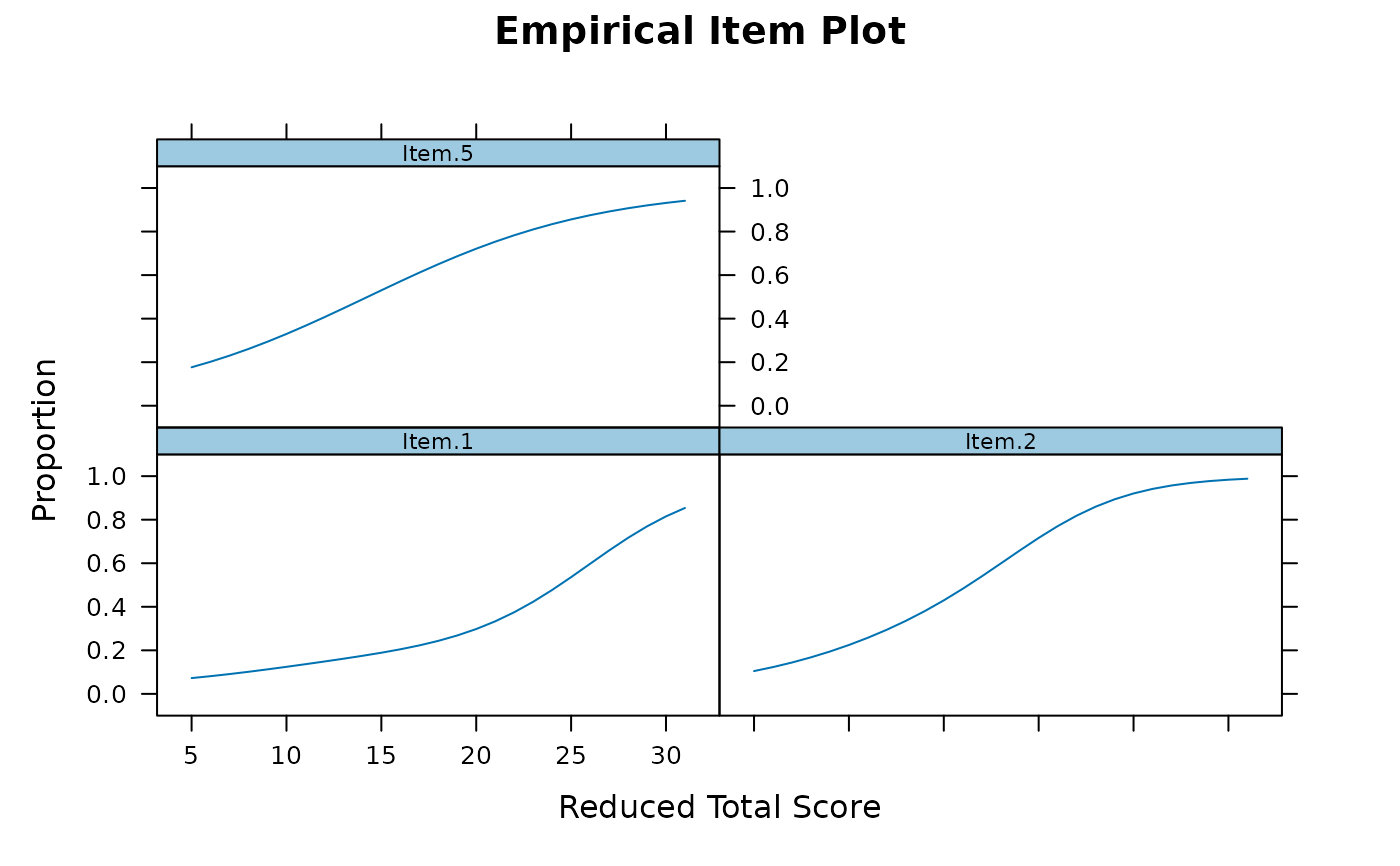
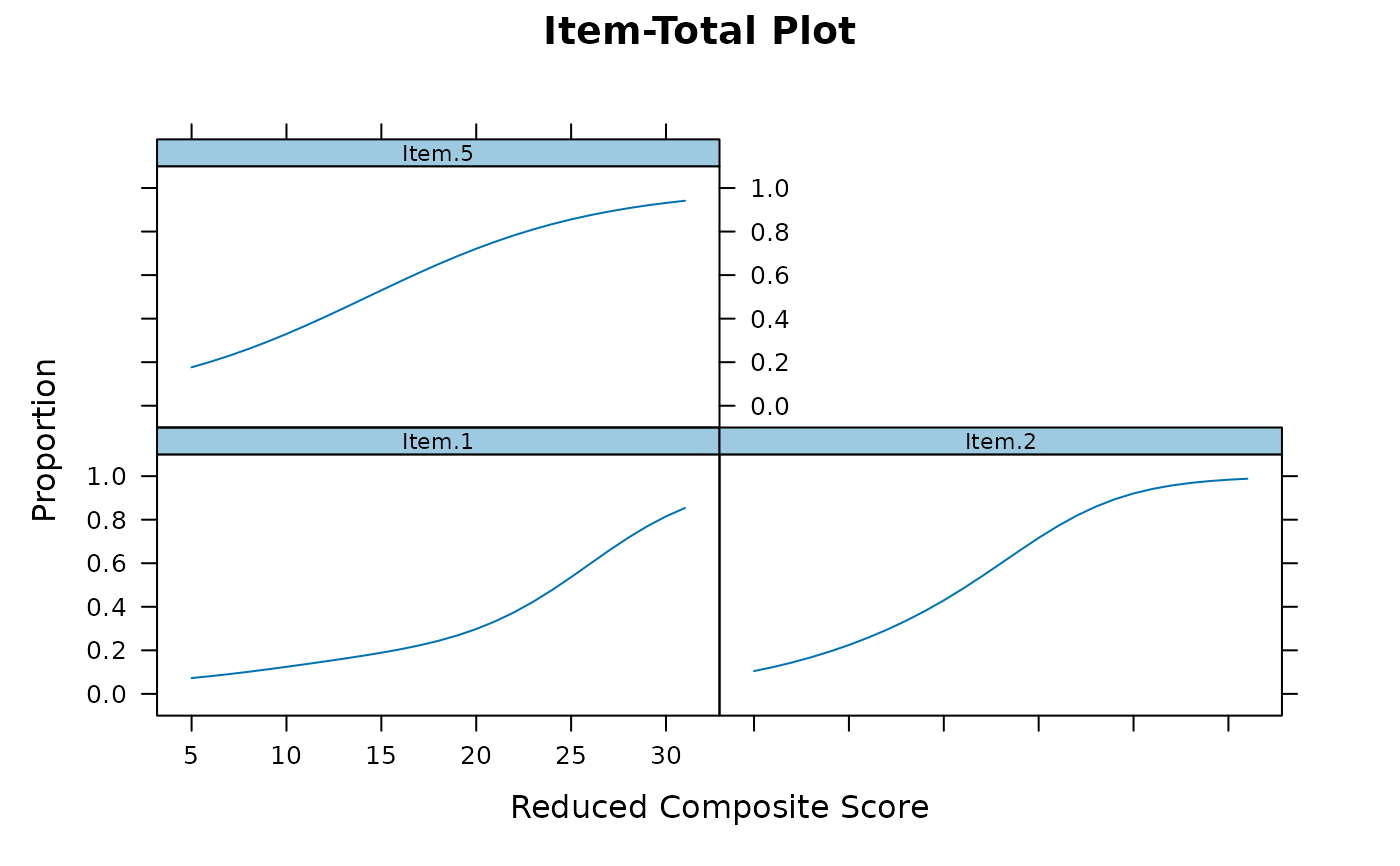
 empirical_plot(data, c(1, 2, 5), smooth = TRUE)
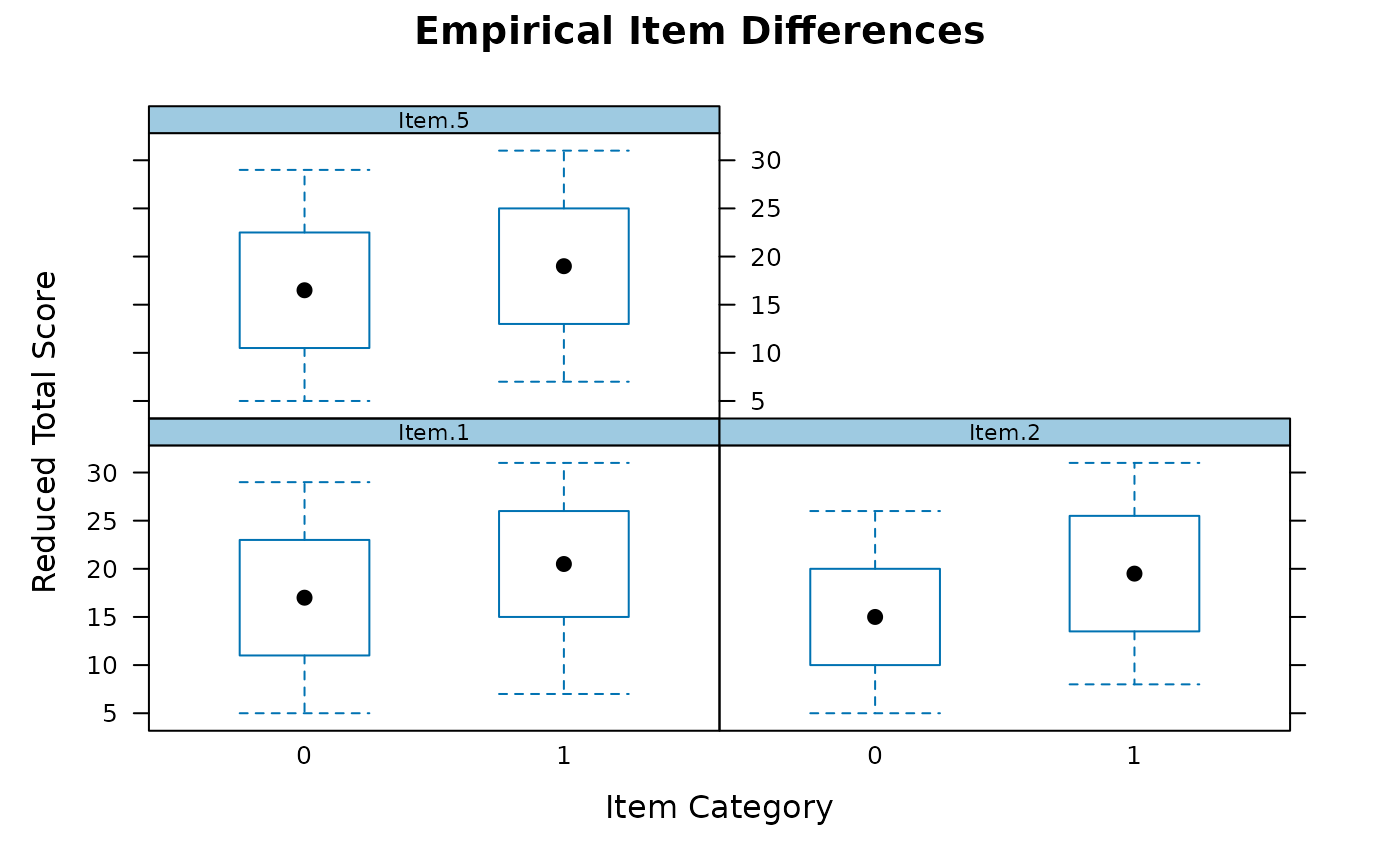
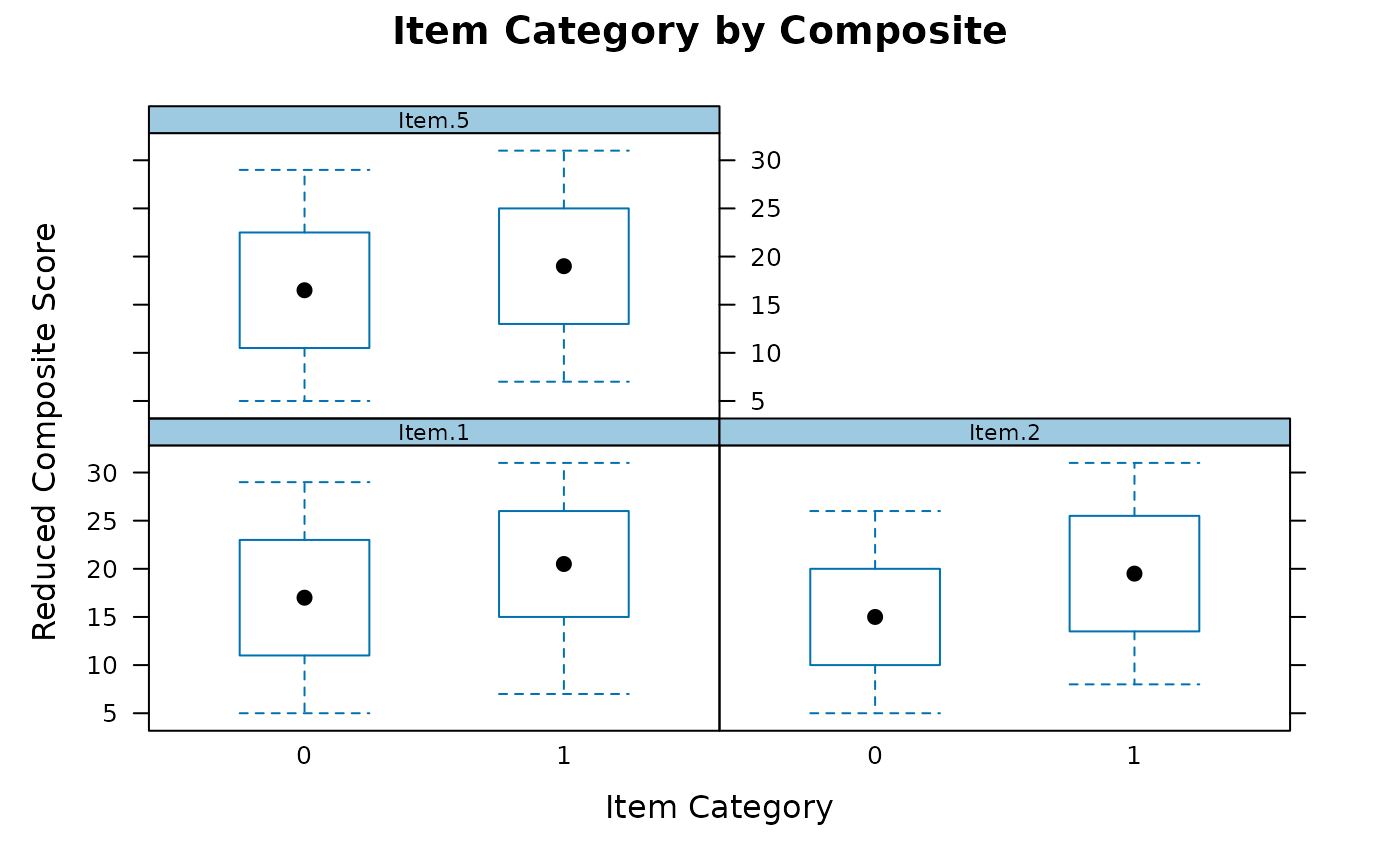
 empirical_plot(data, c(1, 2, 5), type = 'boxplot')
 empirical_plot(data, c(1, 2), type = 'bubble')
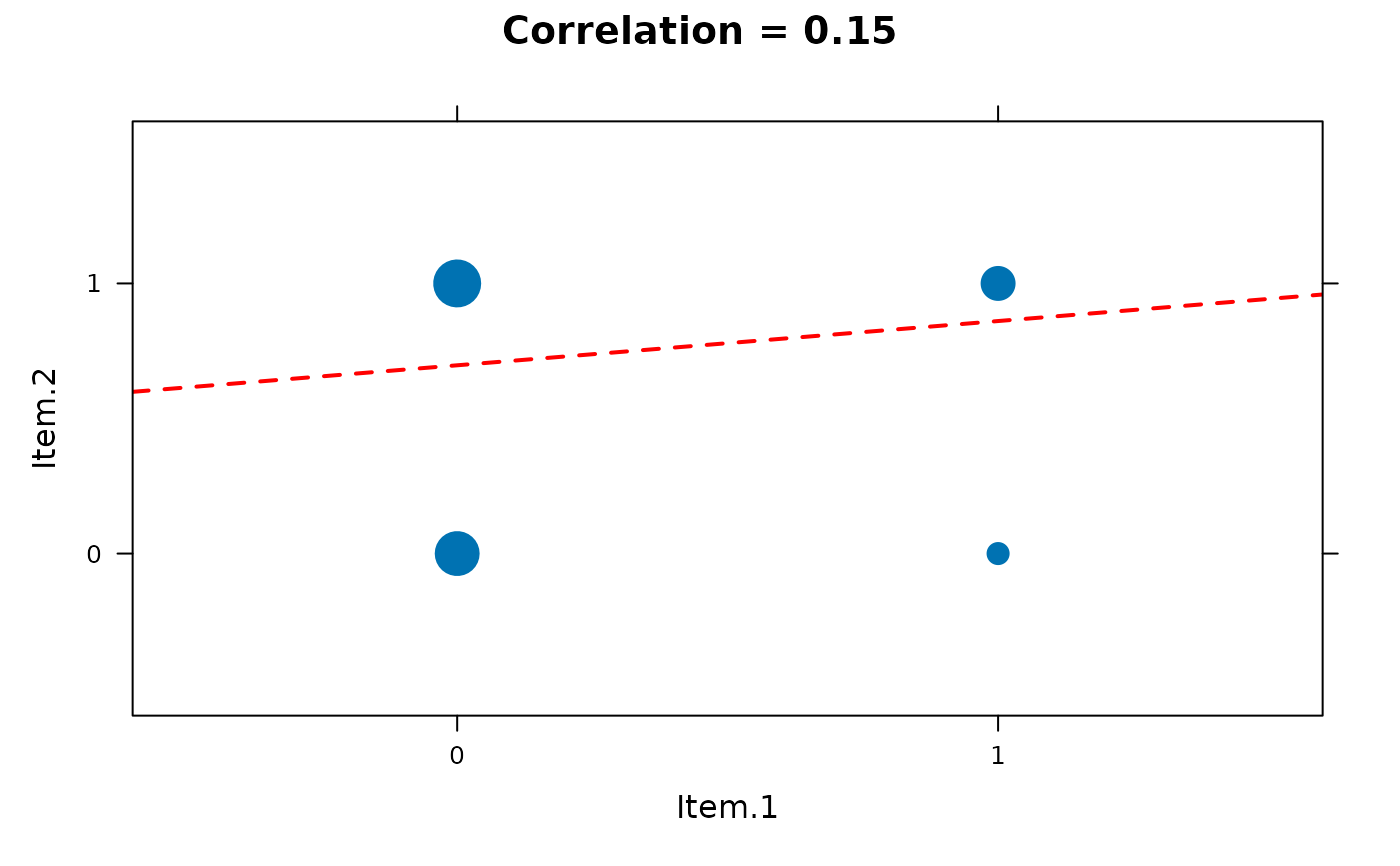 empirical_plot(data, c(1, 5), type = 'bubble')
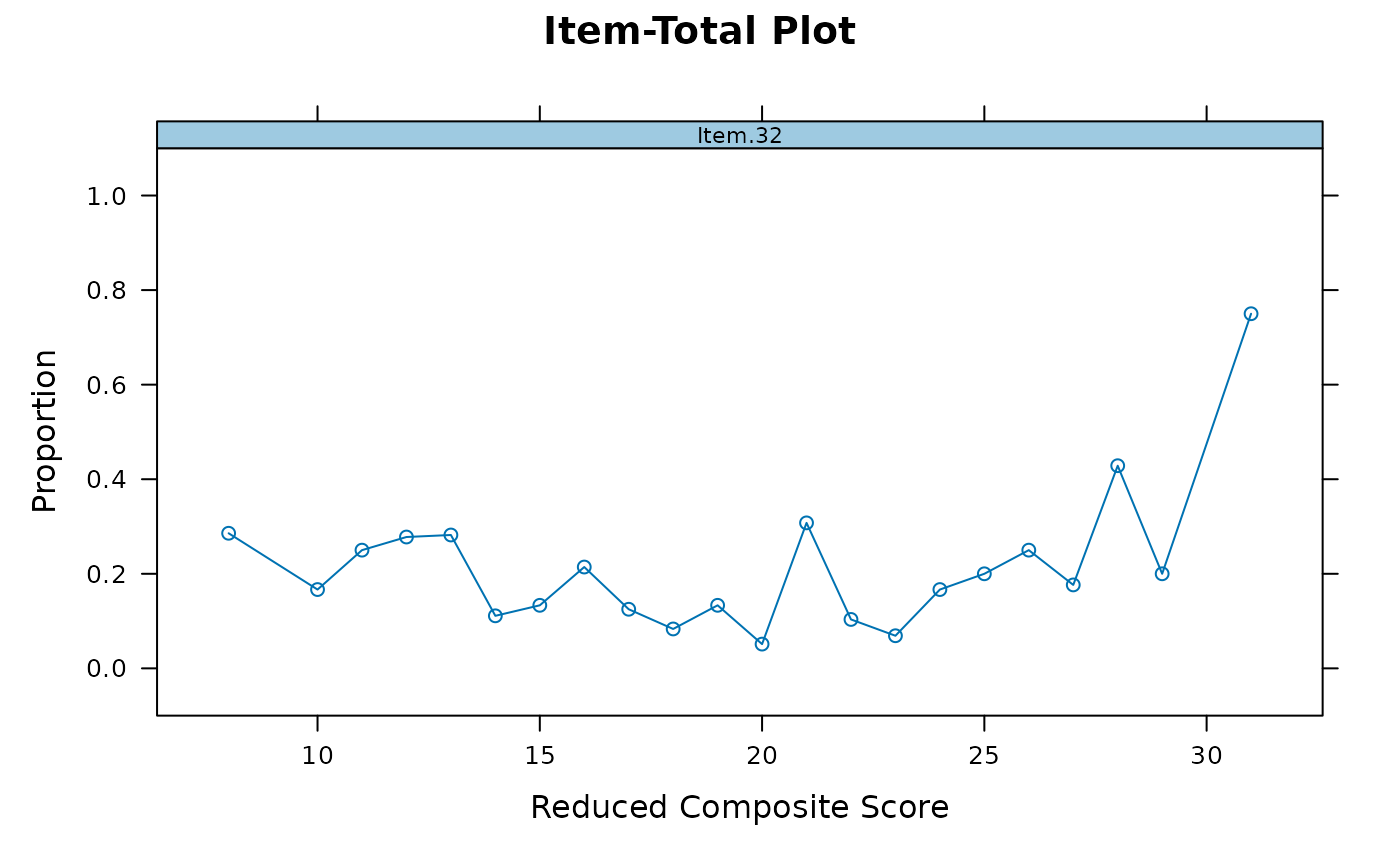
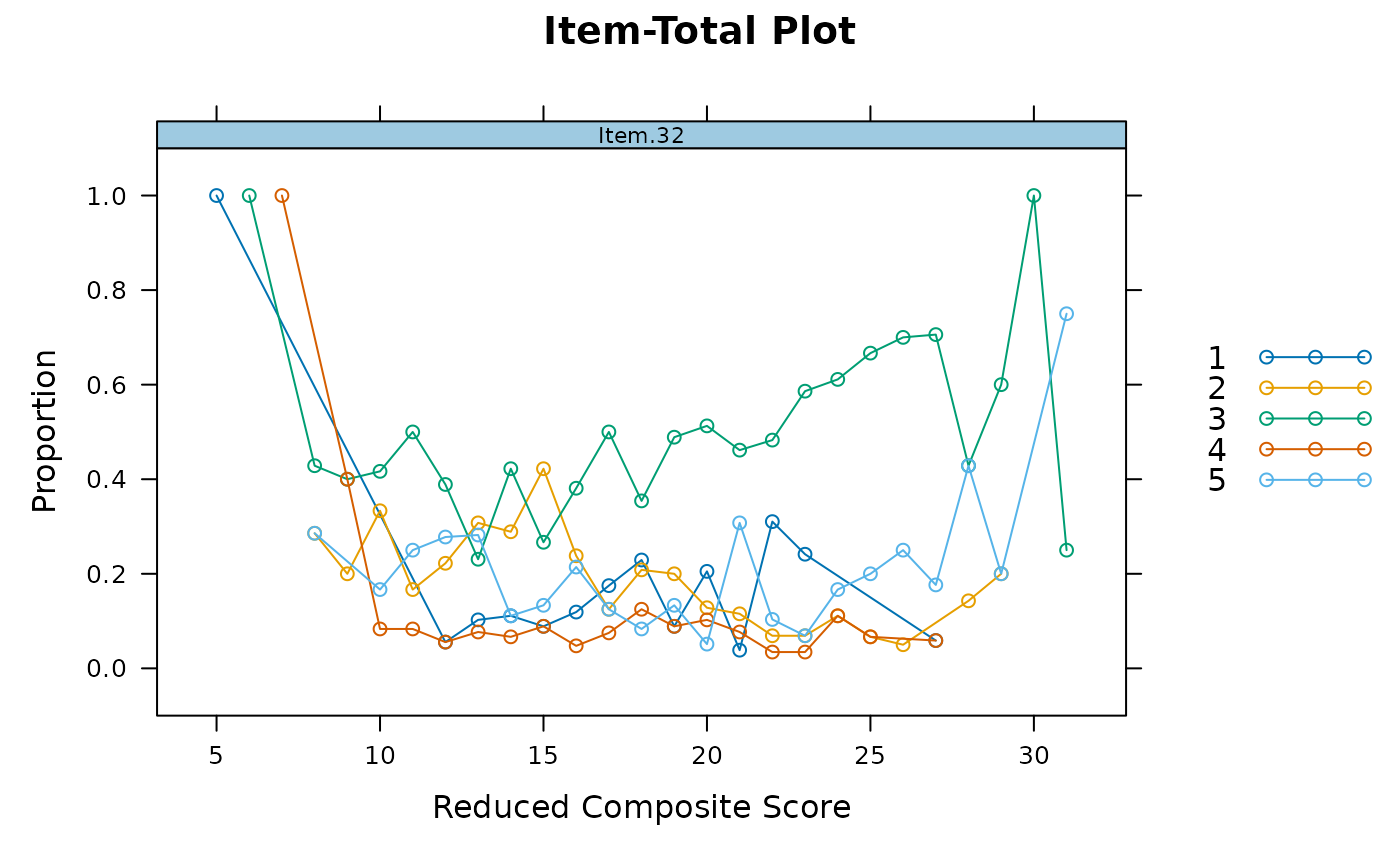
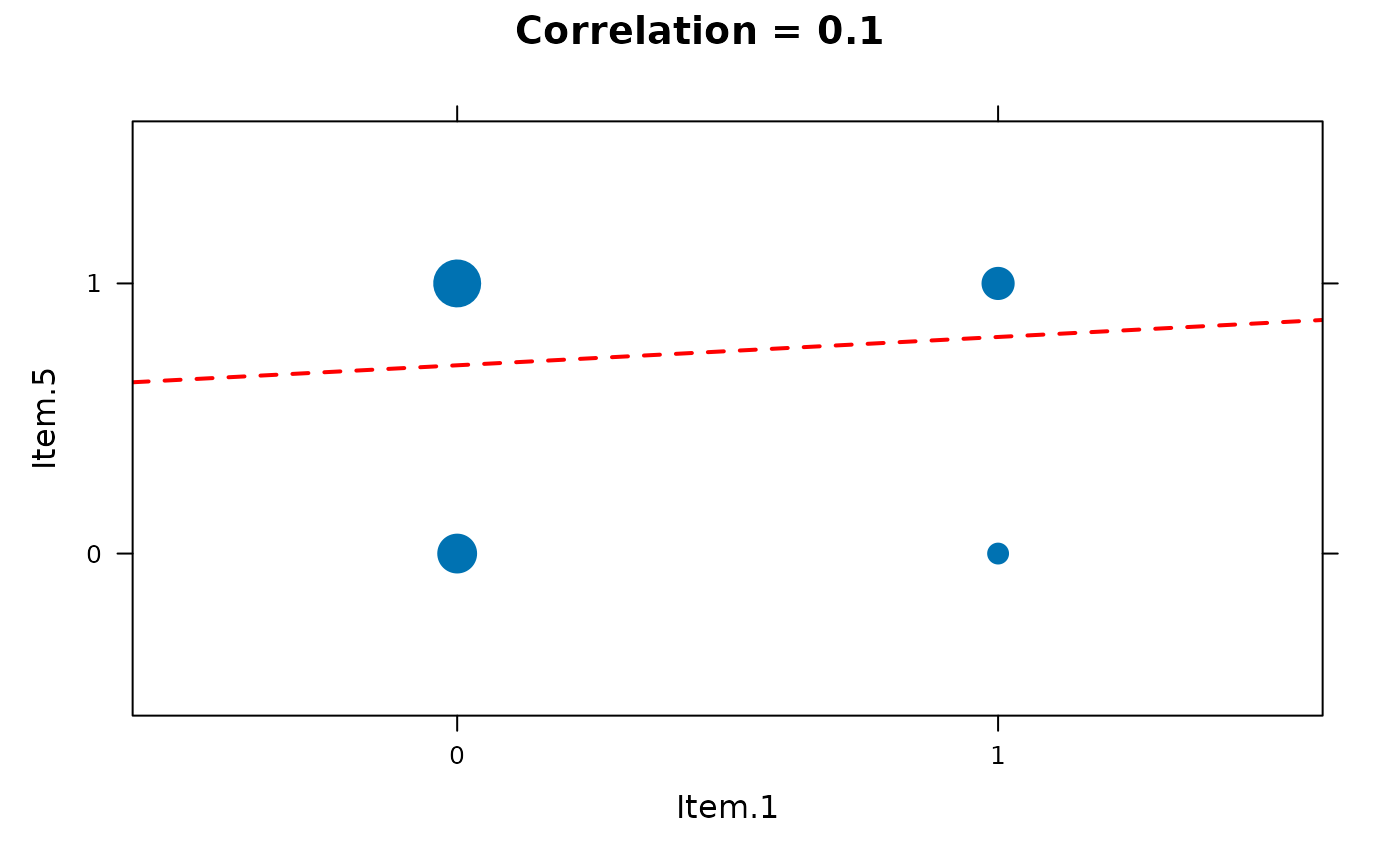 # replace weird looking items with unscored versions for diagnostics
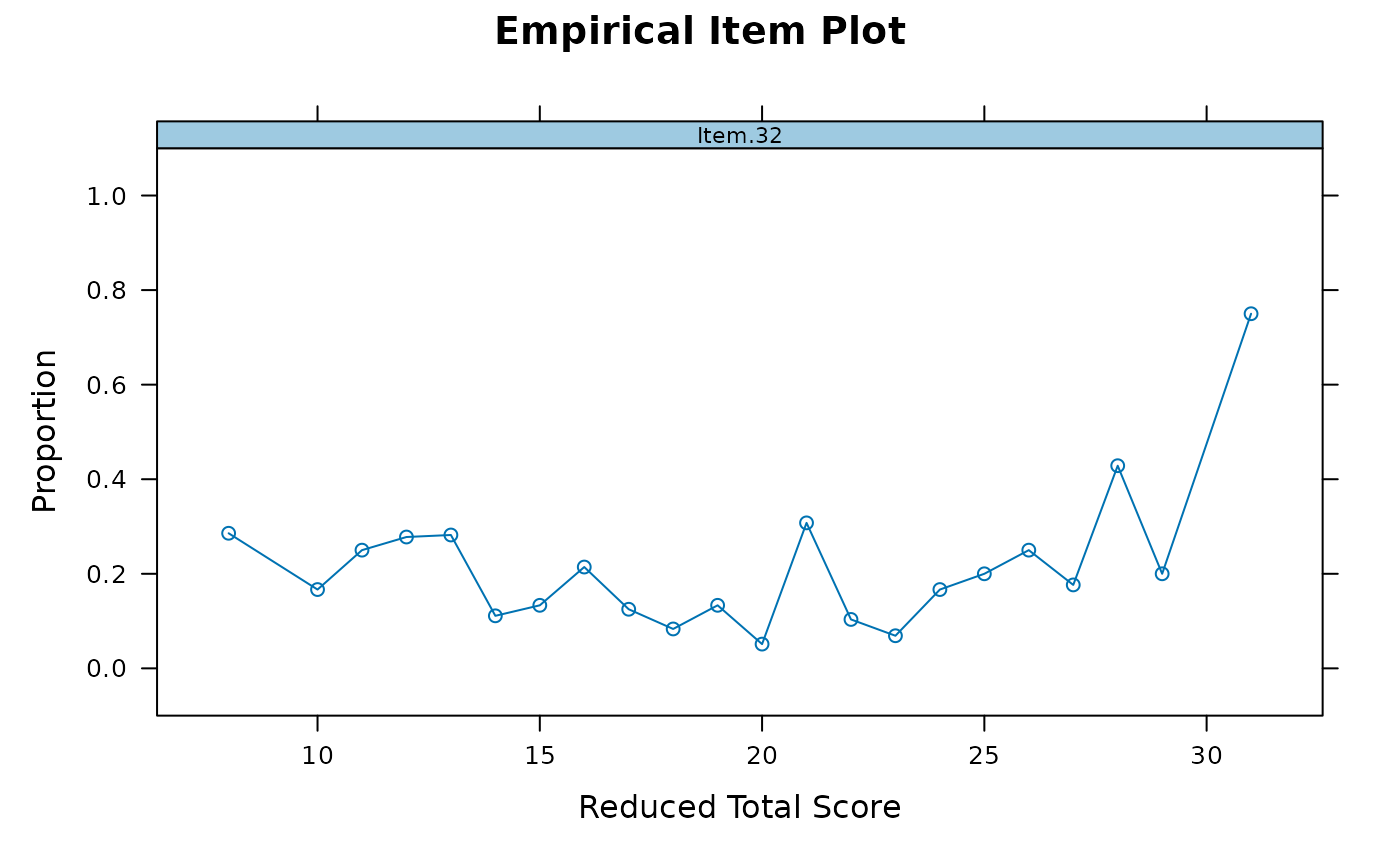
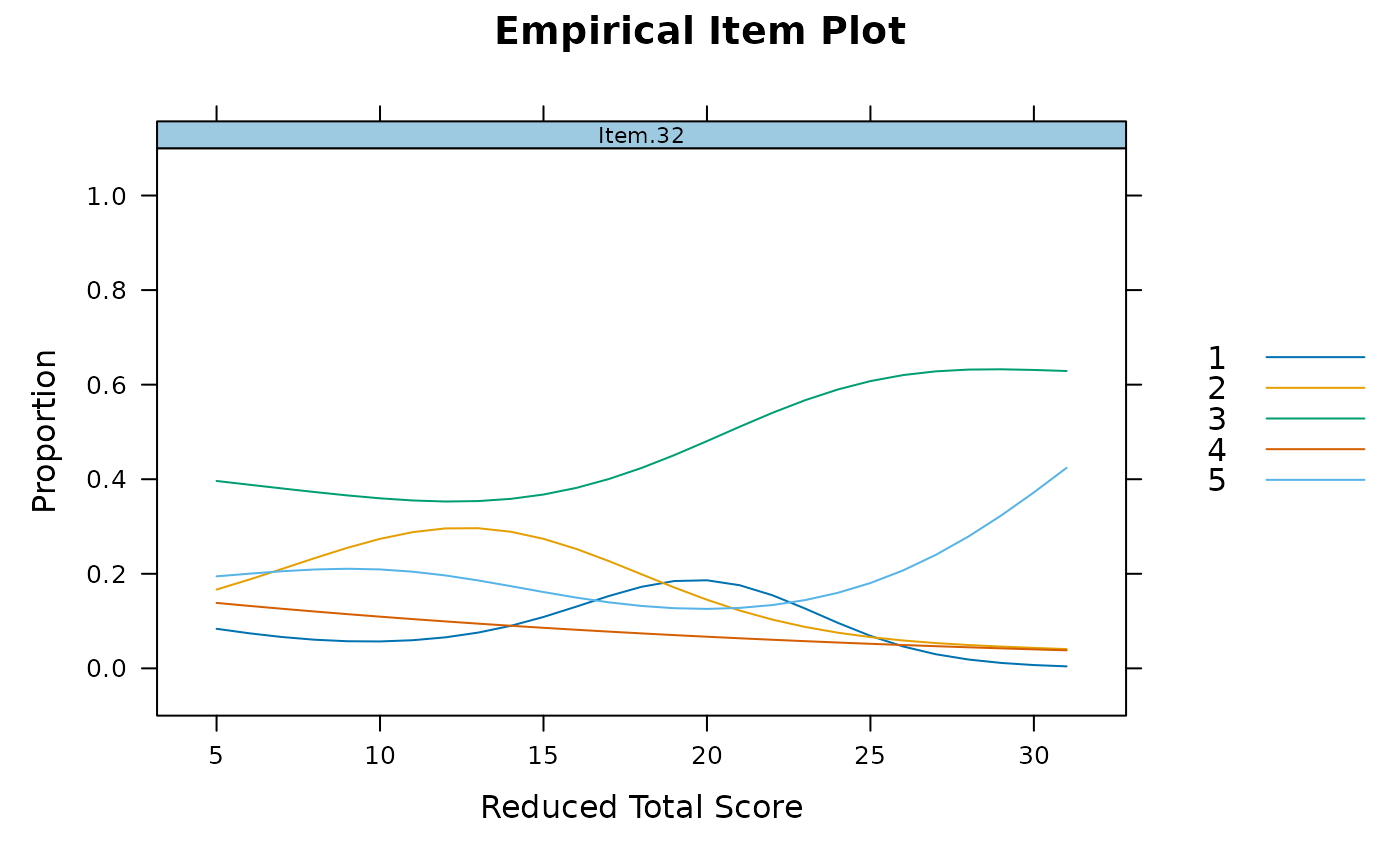
empirical_plot(data, 32)
 data2 <- data
data2[,32] <- SAT12[,32]
empirical_plot(data2, 32)
 empirical_plot(data2, 32, smooth = TRUE)
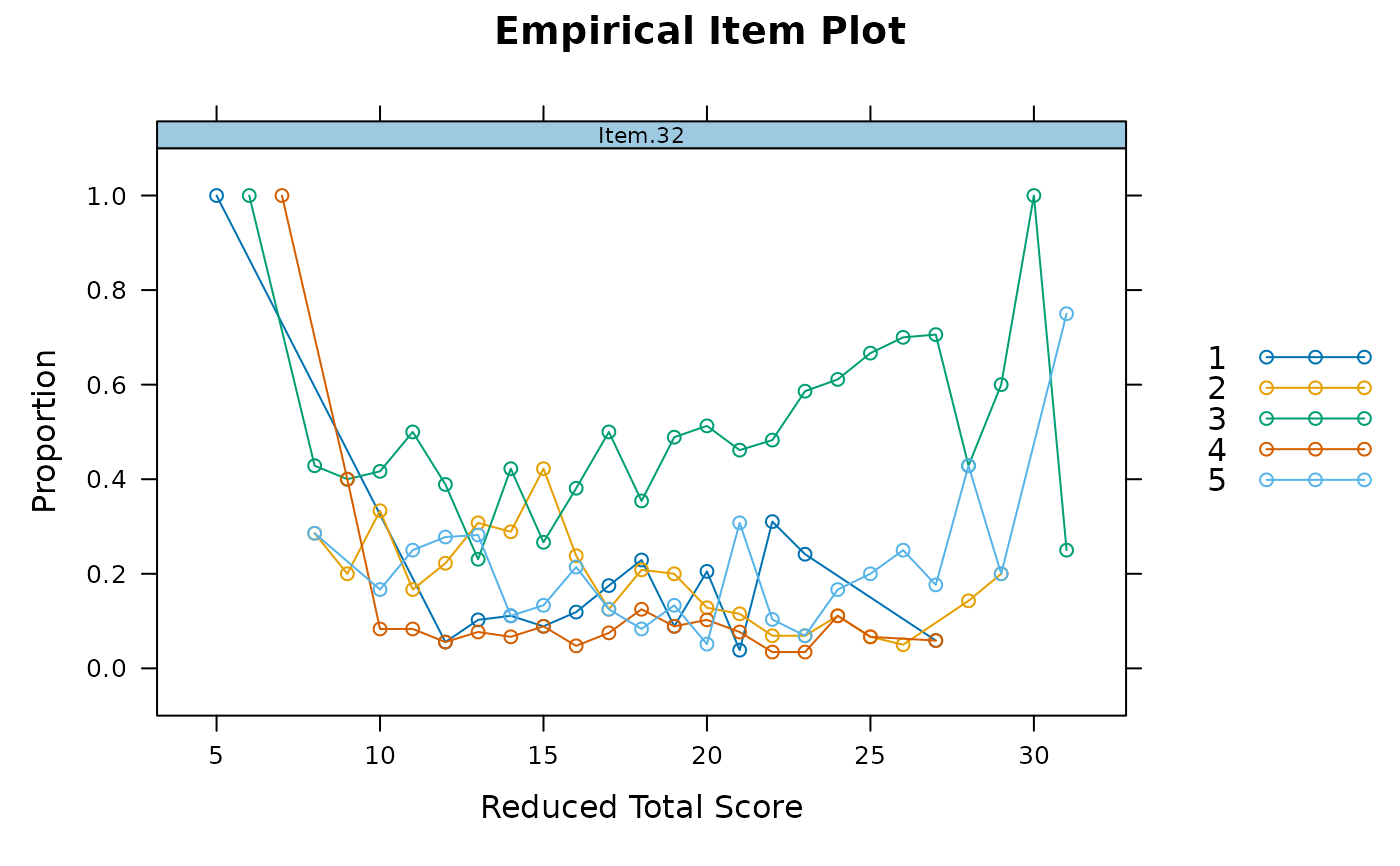
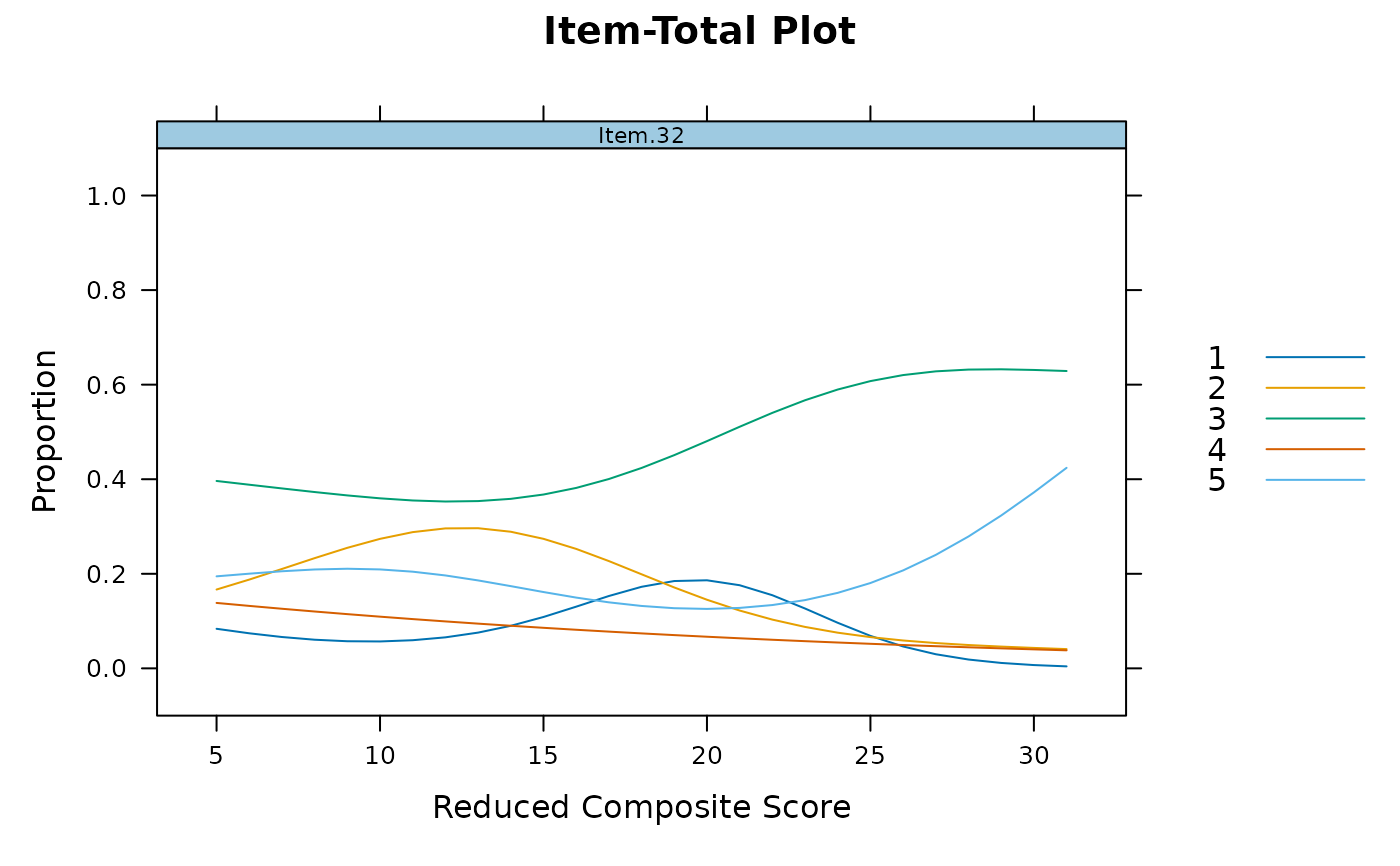 # alternatively, distractor analyses using original dataset
empirical_plot(data, which.items=32, org.data=SAT12)
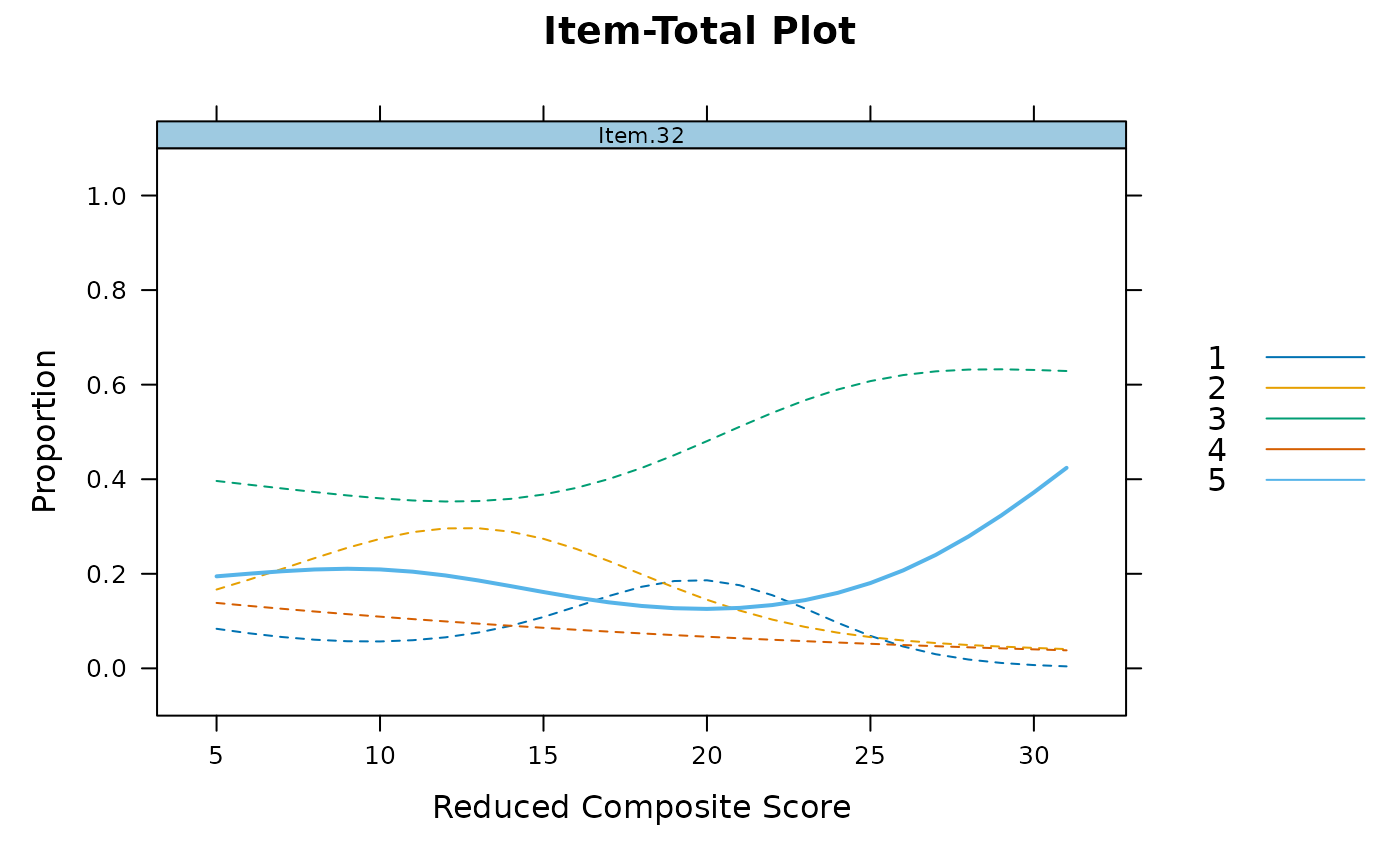
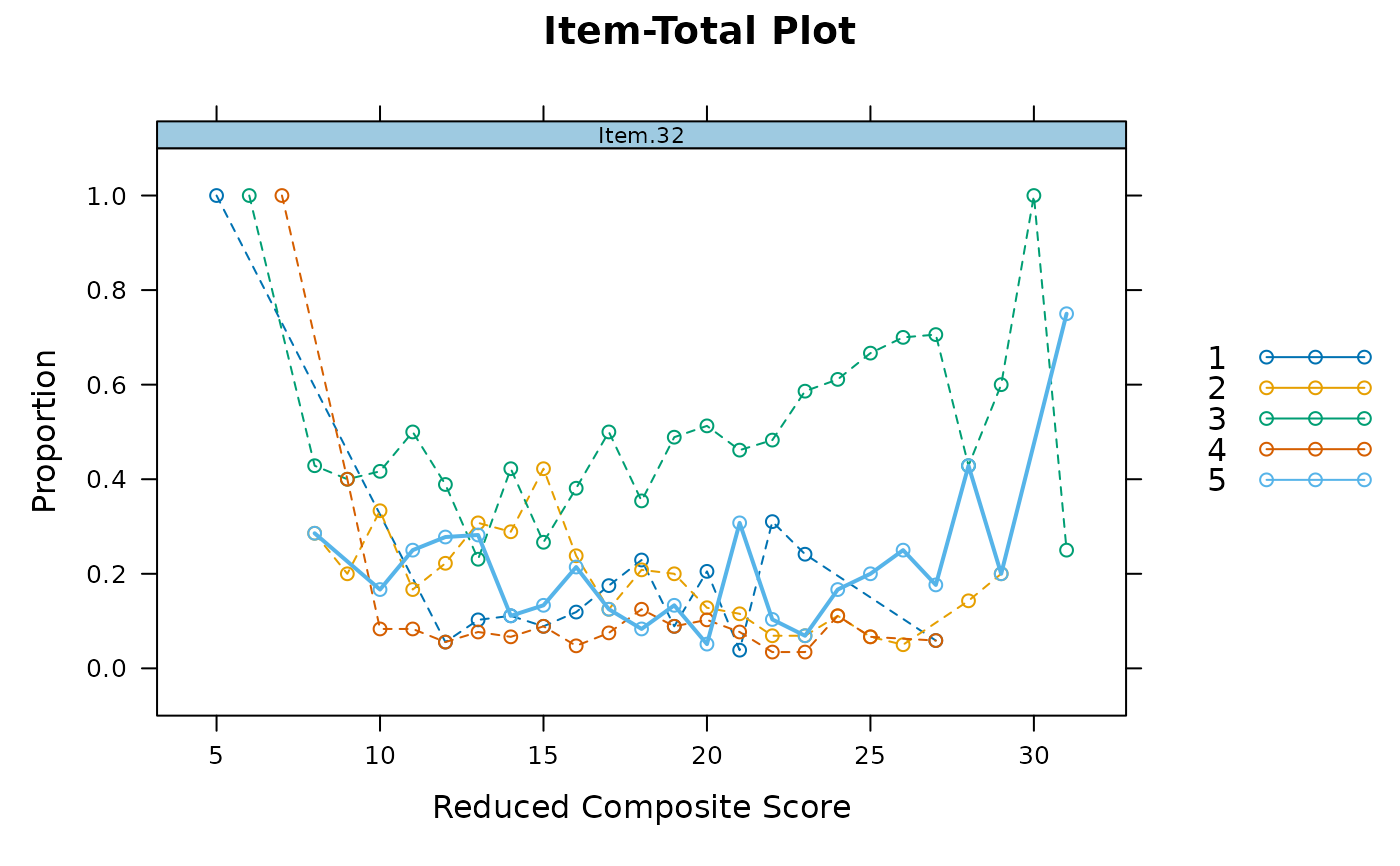 empirical_plot(data, which.items=32, org.data=SAT12, smooth=TRUE)
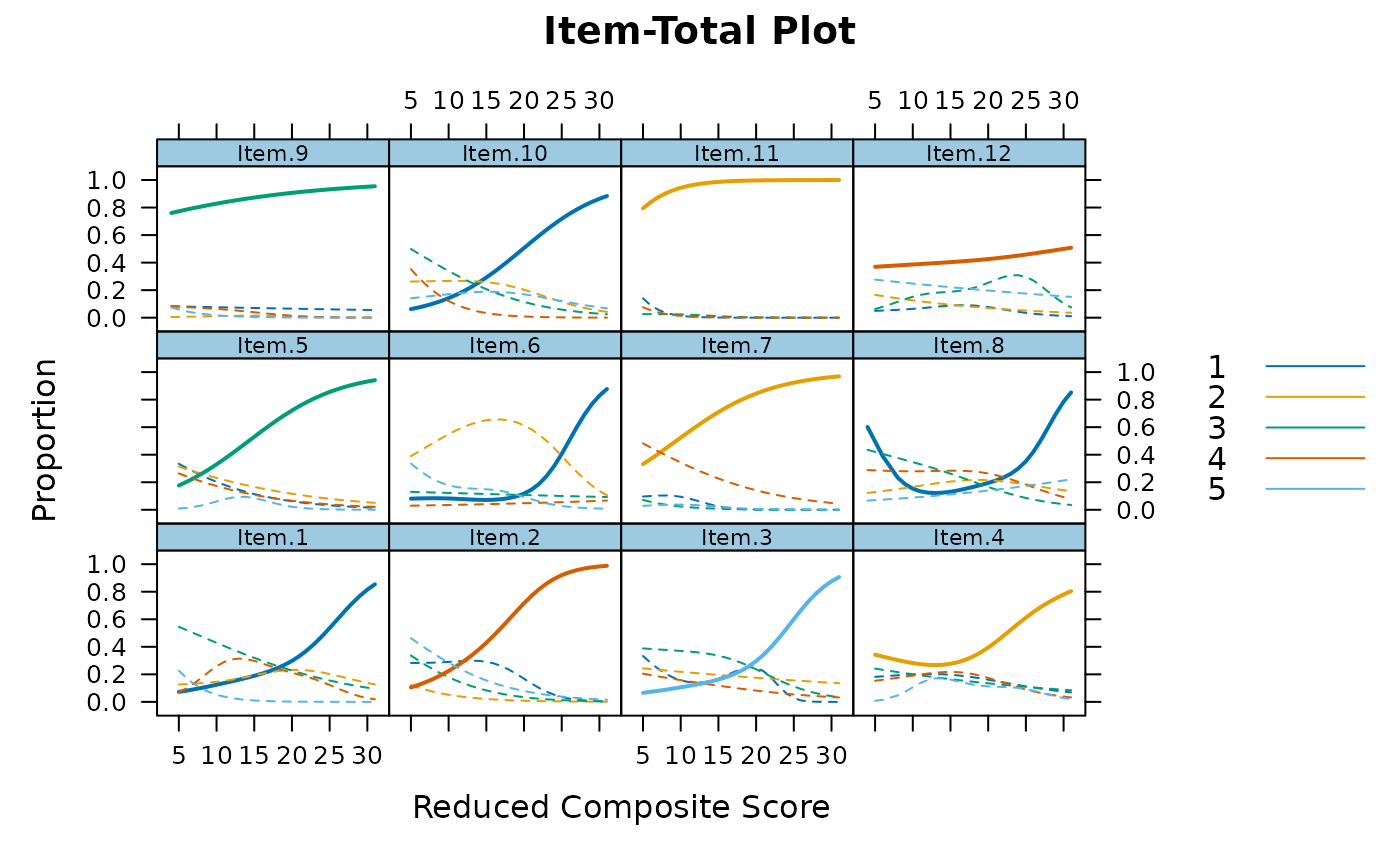
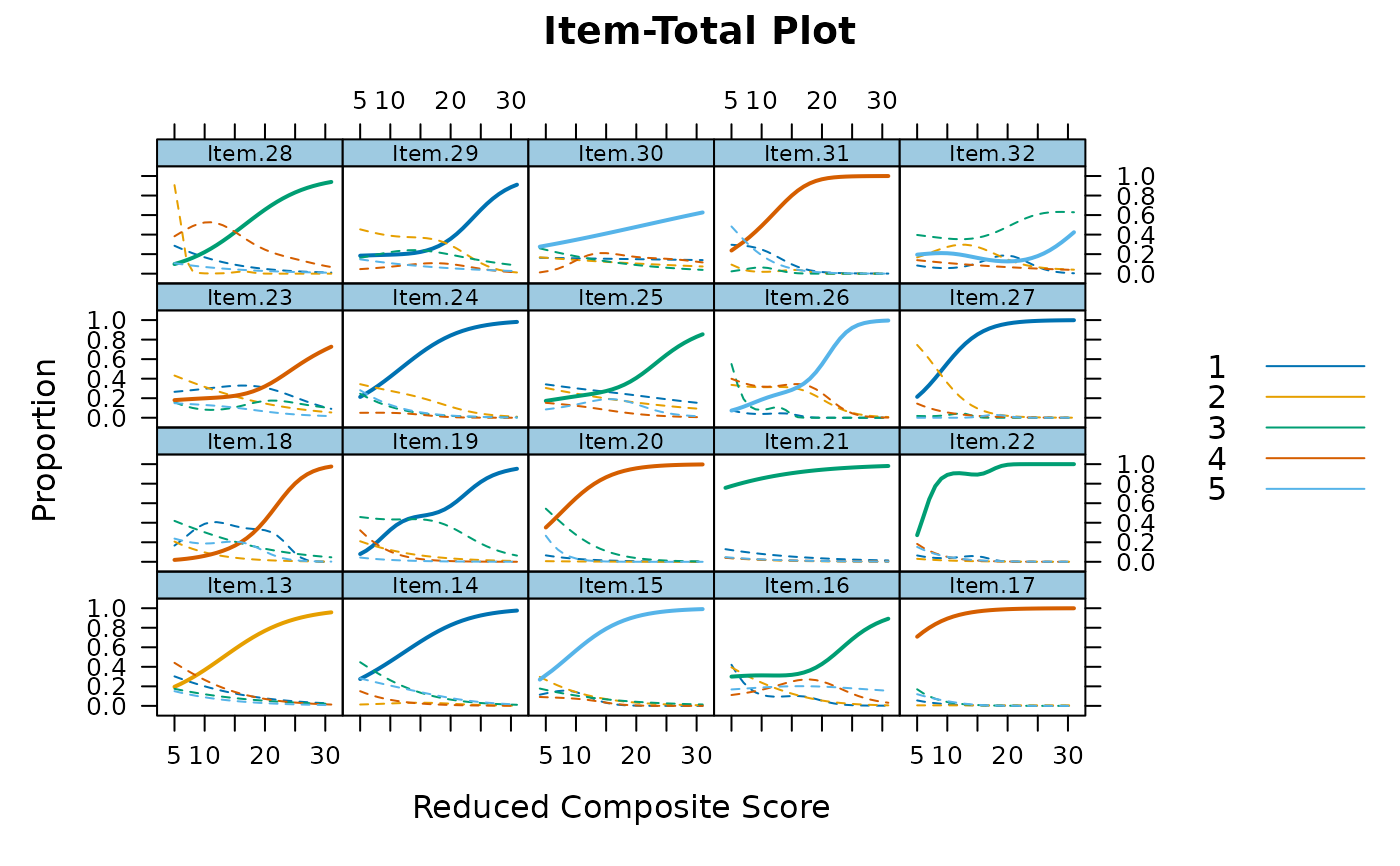
 empirical_plot(data, which.items=1:12, org.data=SAT12, smooth=TRUE)
 empirical_plot(data, which.items=13:32, org.data=SAT12, smooth=TRUE)
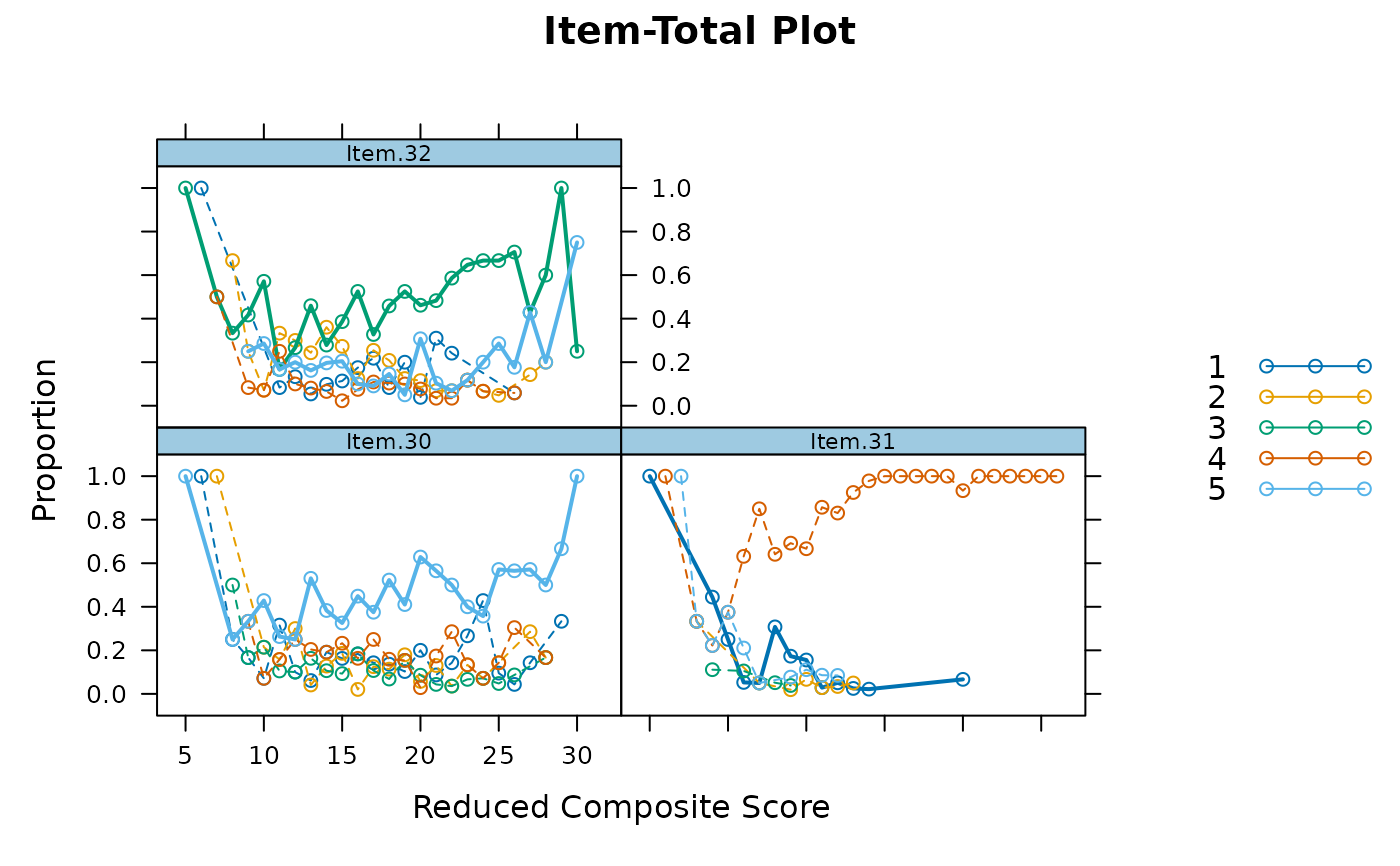
 # example where item 32 has two correct scoring keys, and item 31
# is incorrectly scored (perhaps miskeyed)
key <- cbind(c(1,4,5,2,3,1,2,1,3,1,2,4,2,1,5,3,4,4,1,4,3,3,4,1,3,5,1,3,1,5,1,5),
c(rep(NA, 31), 3))
data2 <- key2binary(SAT12, key=key)
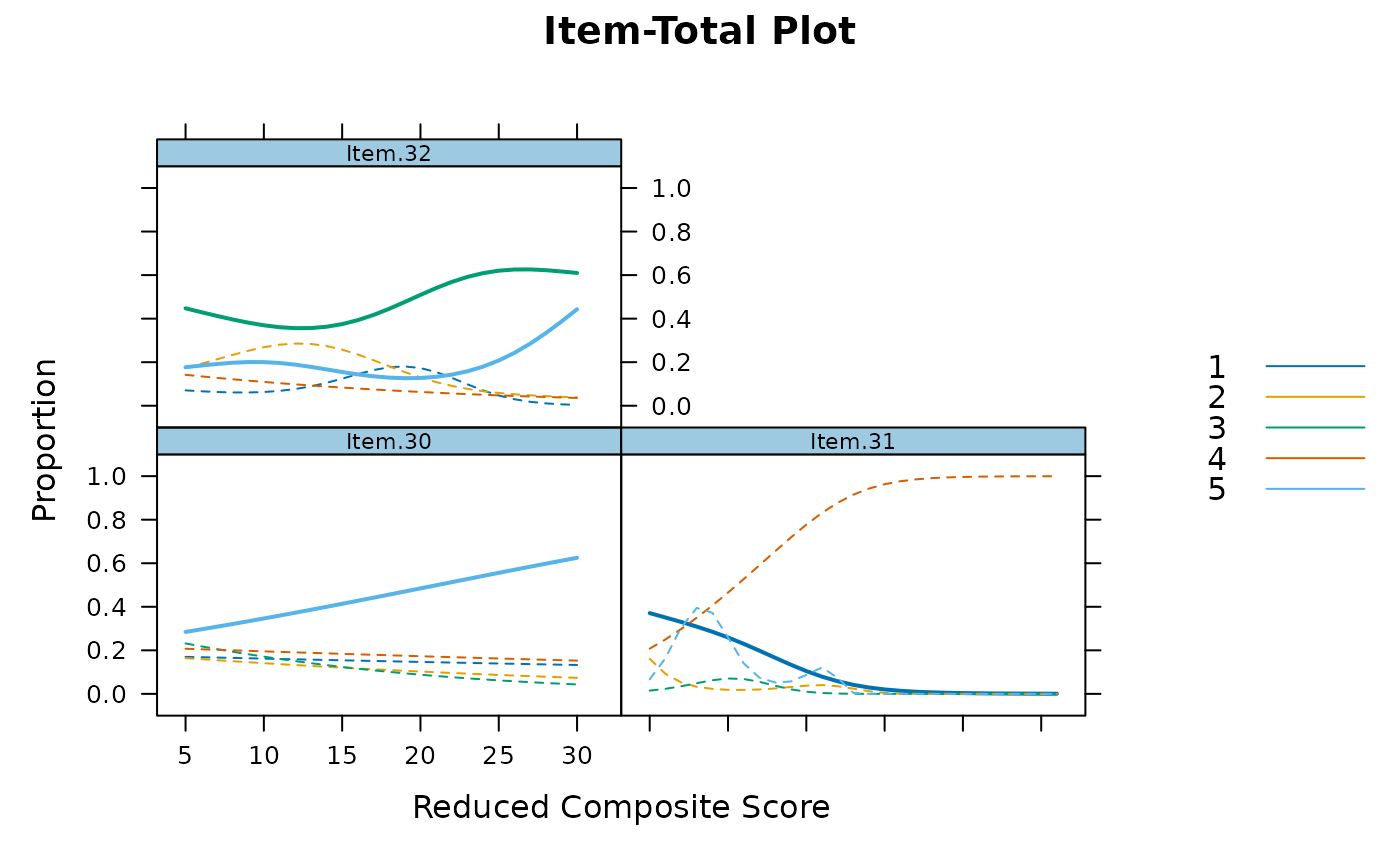
# item 30 is correct, but 31 proportions do not climb. Item 32 has two
# highlighted correct answers
empirical_plot(data2, which.items=30:32, org.data=SAT12)
 empirical_plot(data2, which.items=30:32, org.data=SAT12, smooth=TRUE)
 #################
# polytomous response data
empirical_plot(Science)
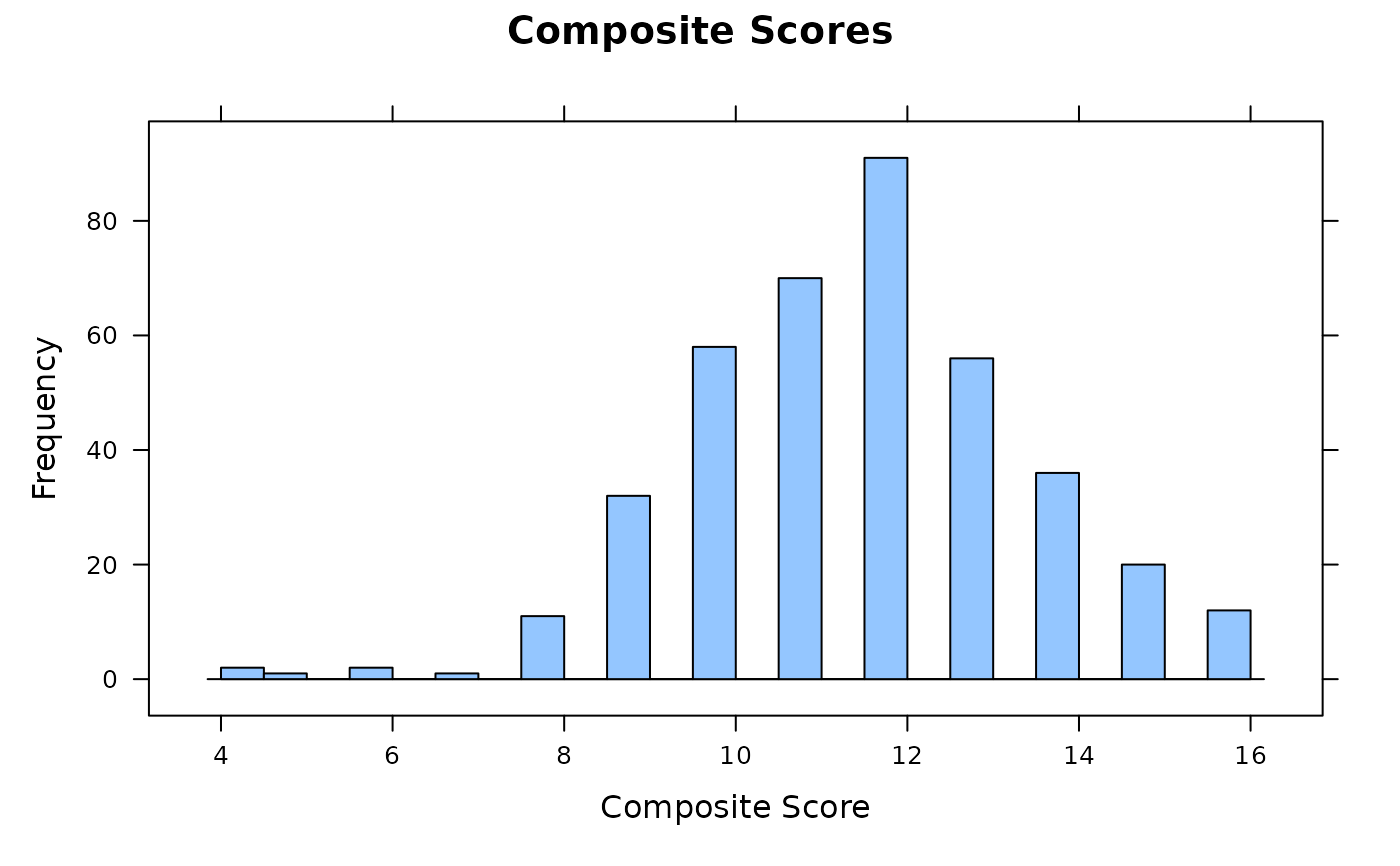
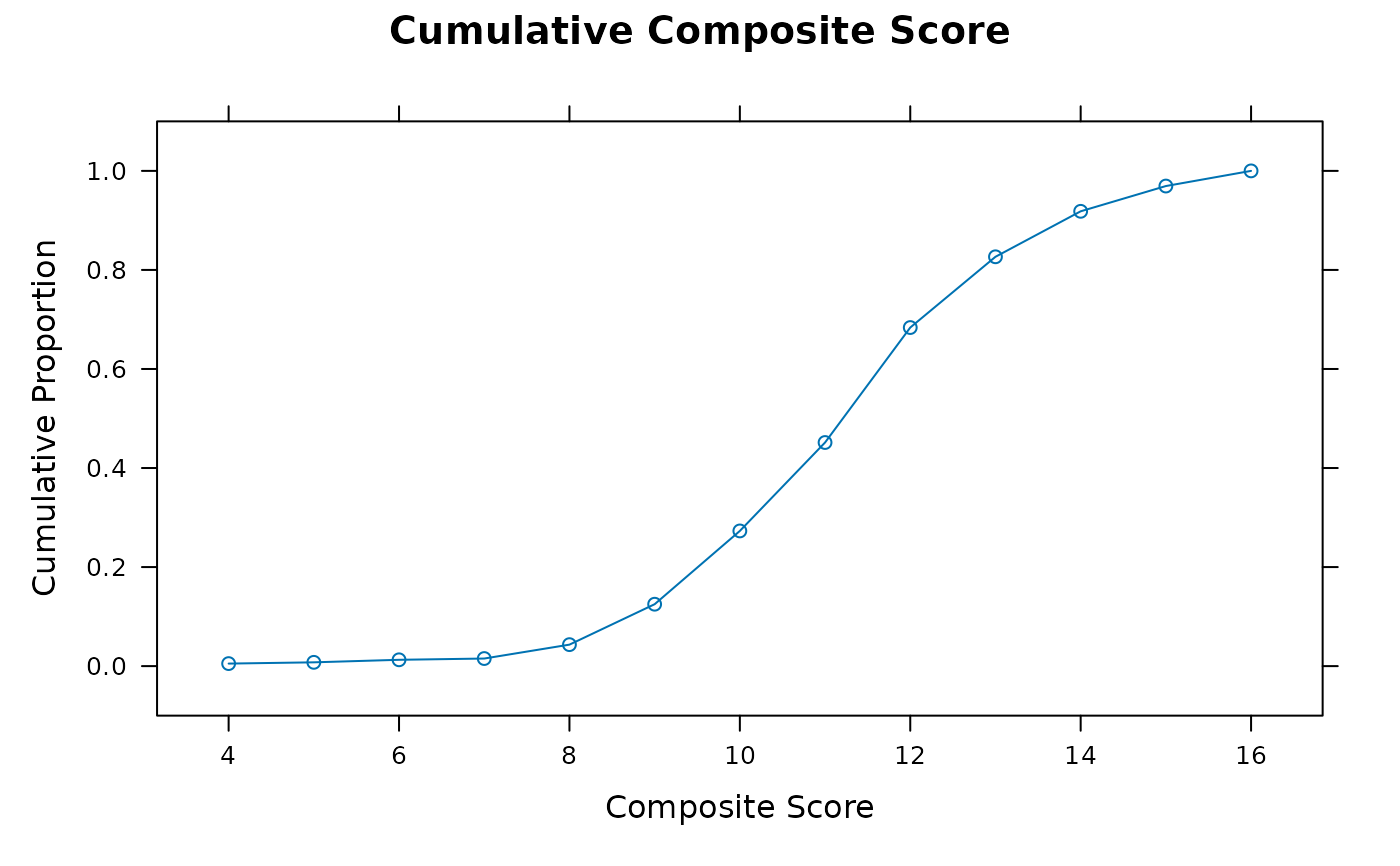 empirical_plot(Science, type = 'hist', breaks=20)
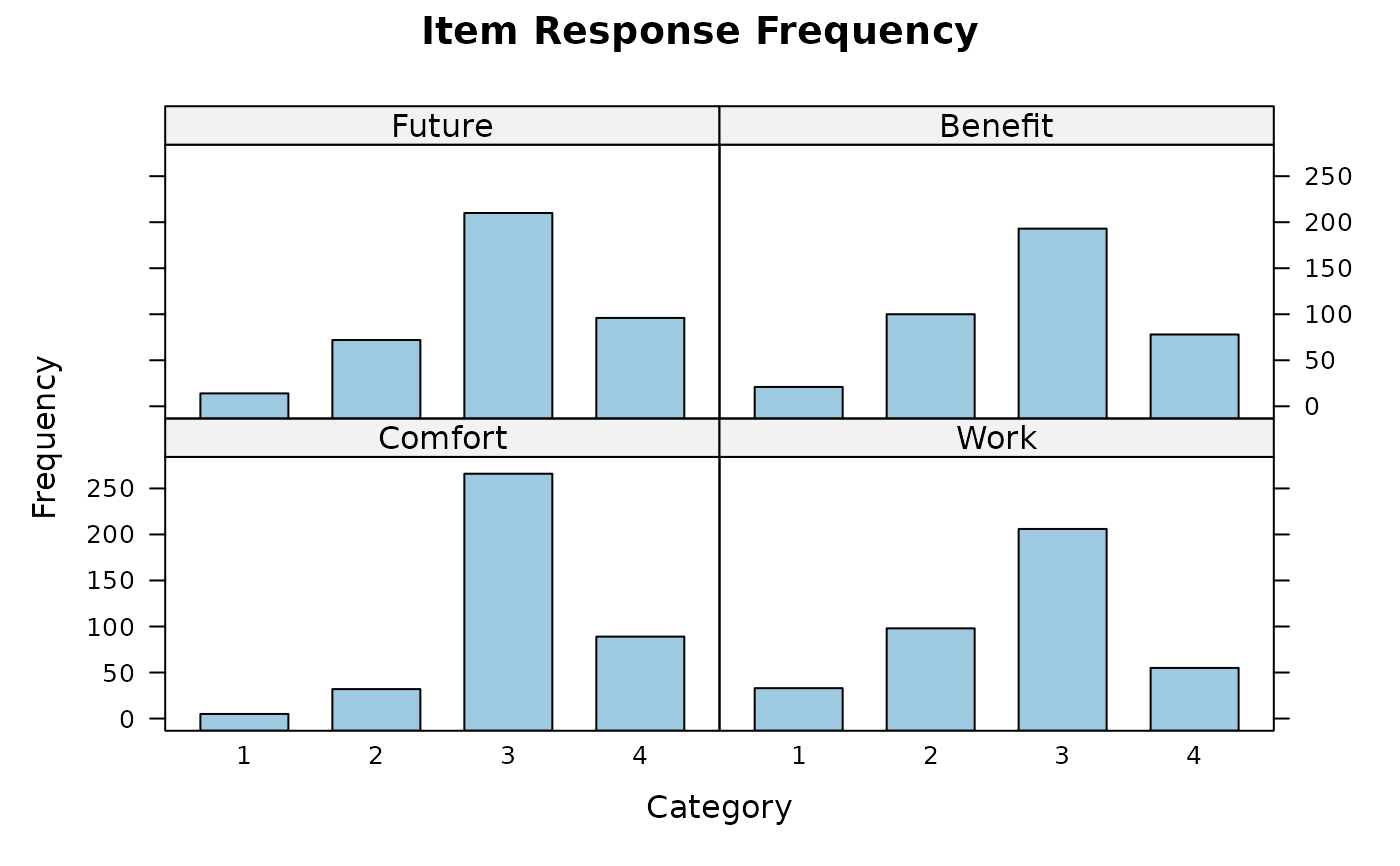
 empirical_plot(Science, type = 'freq')
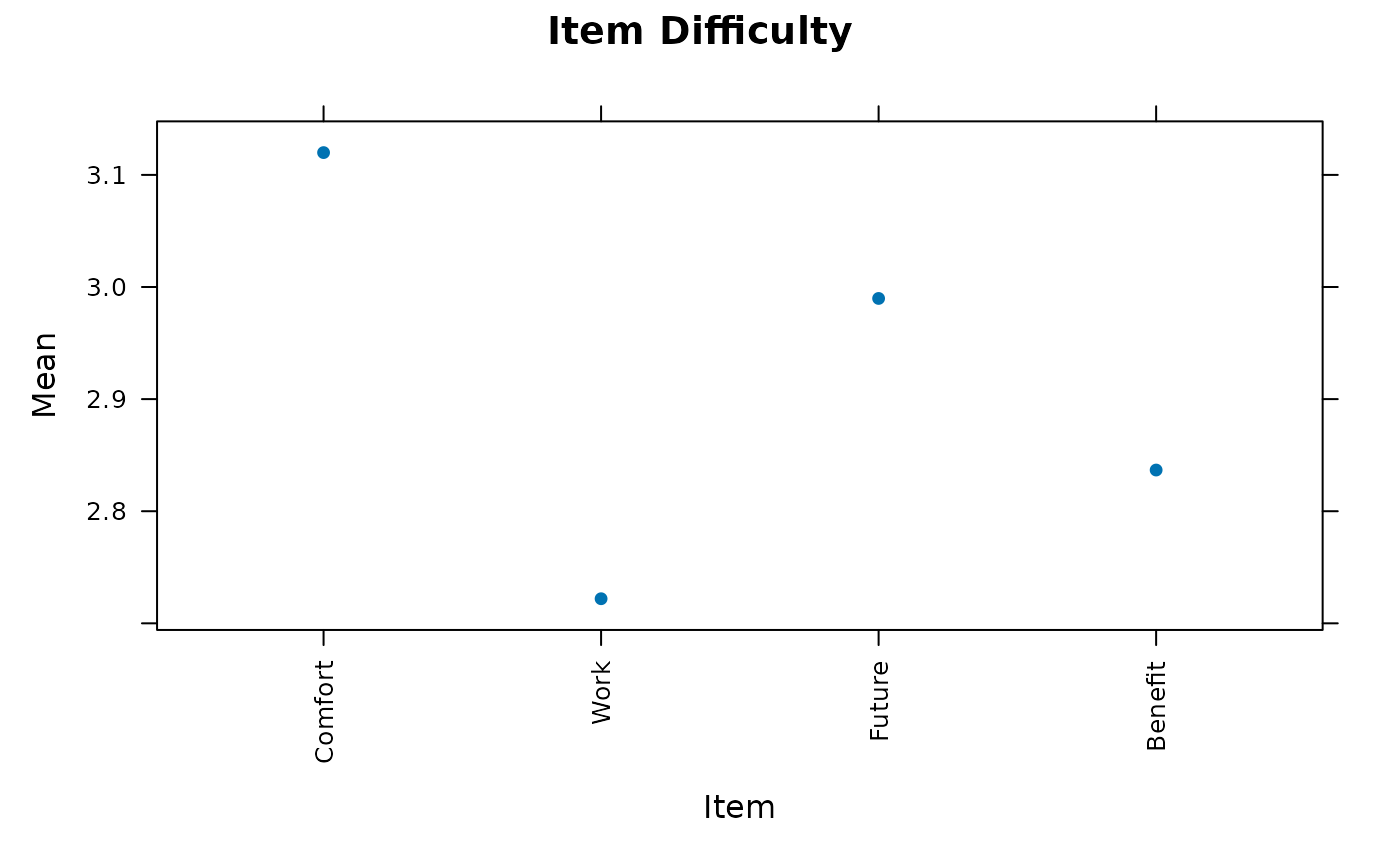
 empirical_plot(Science, type = 'difficulty')
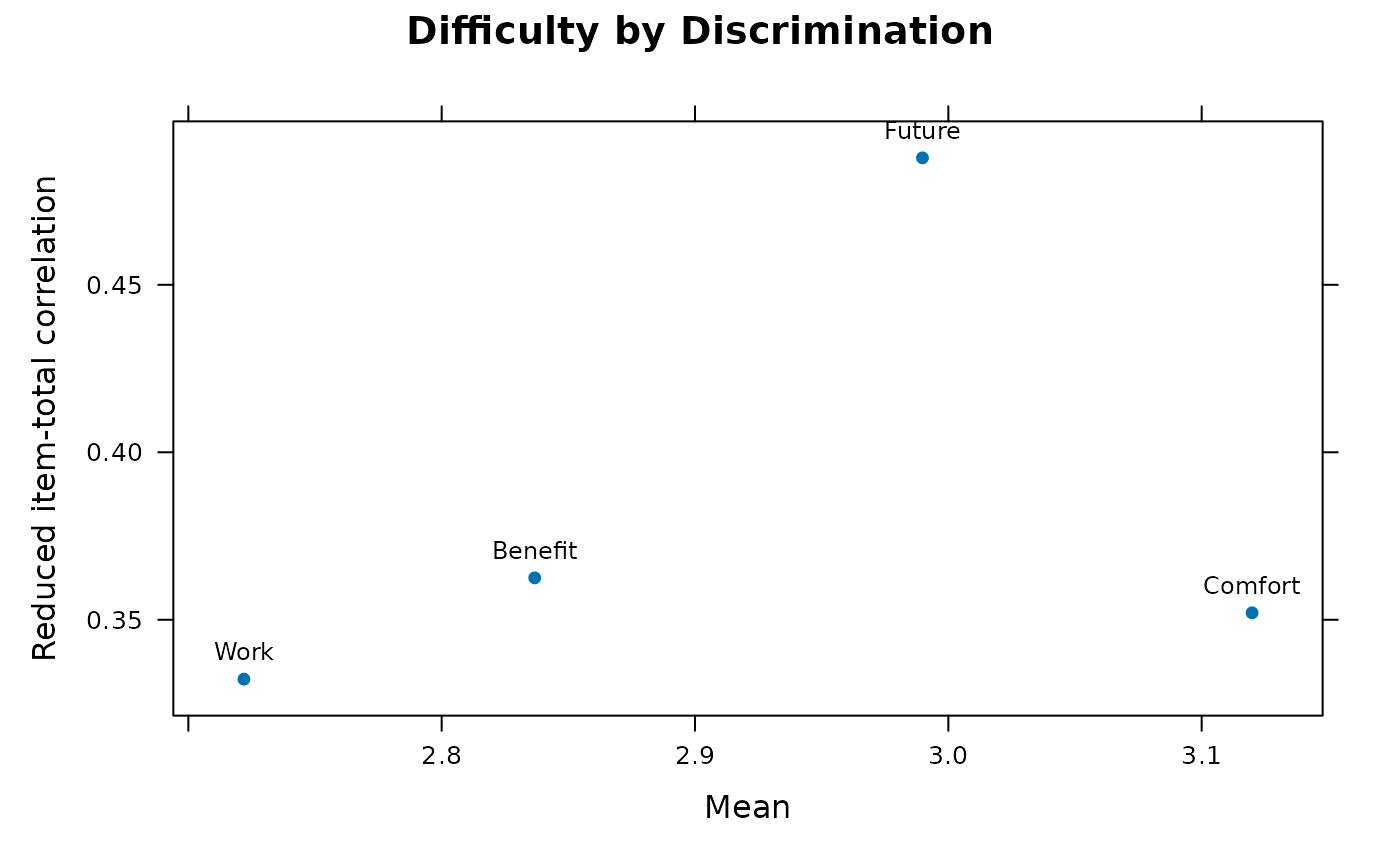
 empirical_plot(Science, type = 'discrim_diff')
 empirical_plot(Science, type = 'boxplot')
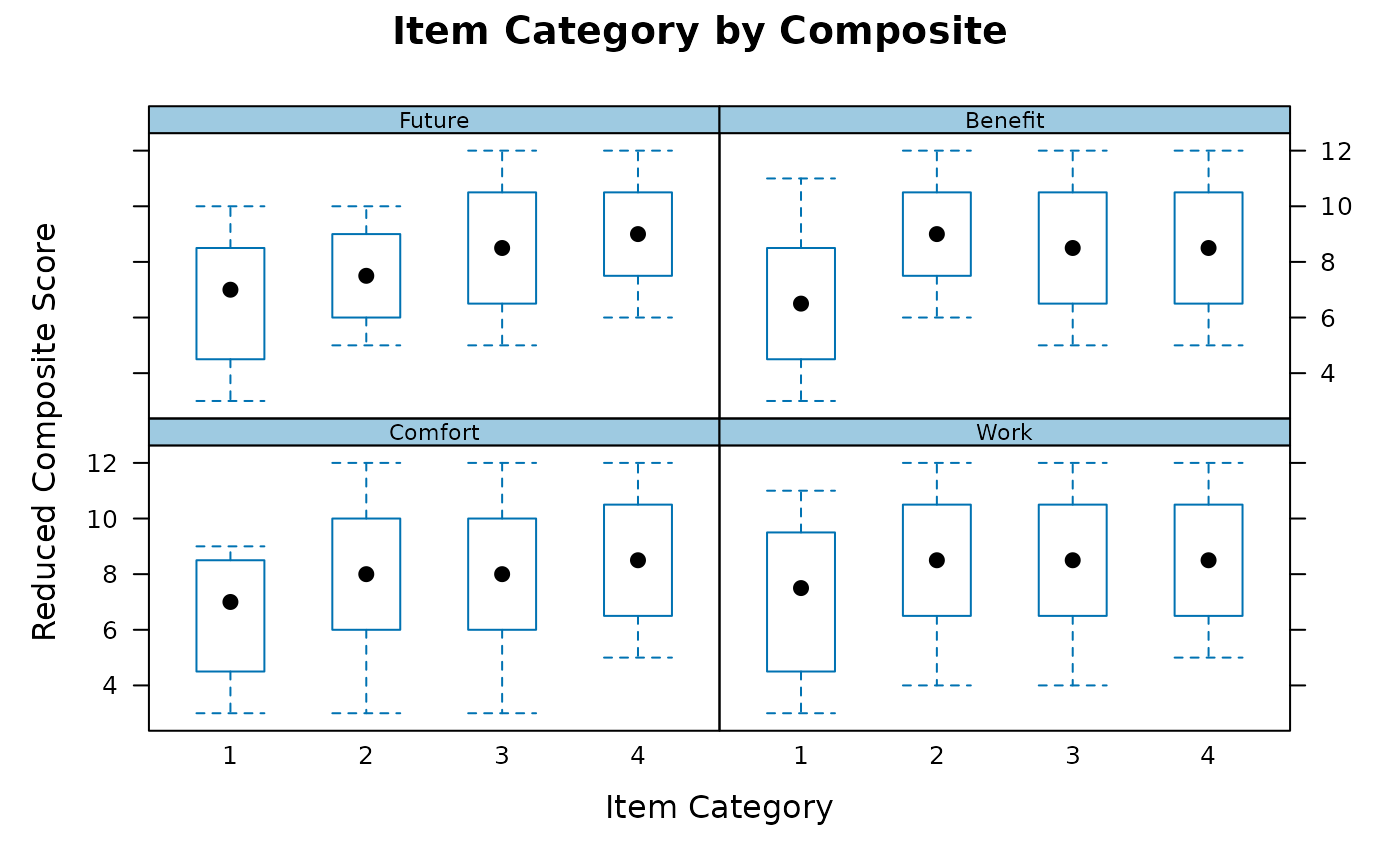 # item-level
empirical_plot(Science, c(1, 2), type = 'bubble')
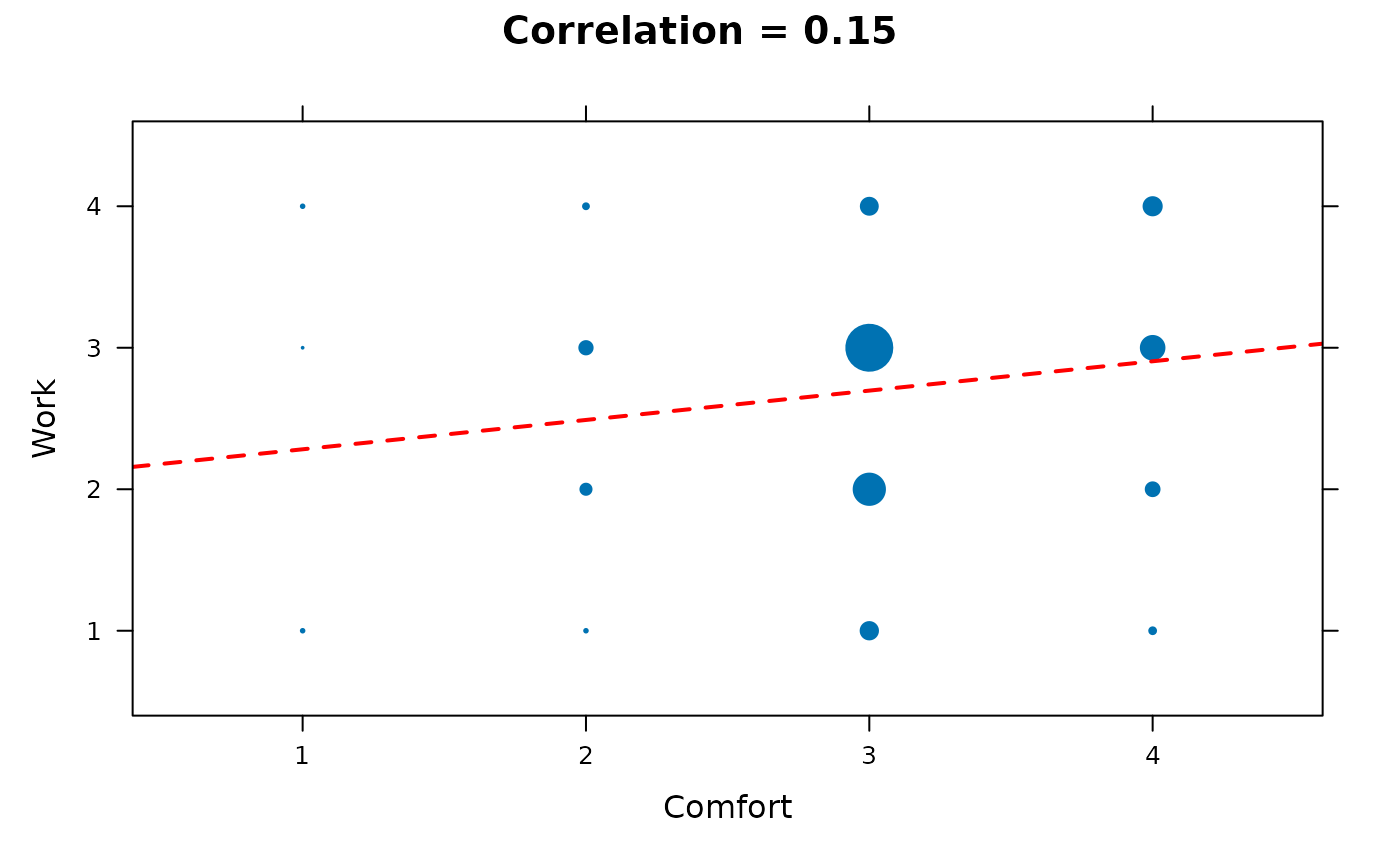 empirical_plot(Science, c(1, 3), type = 'bubble')
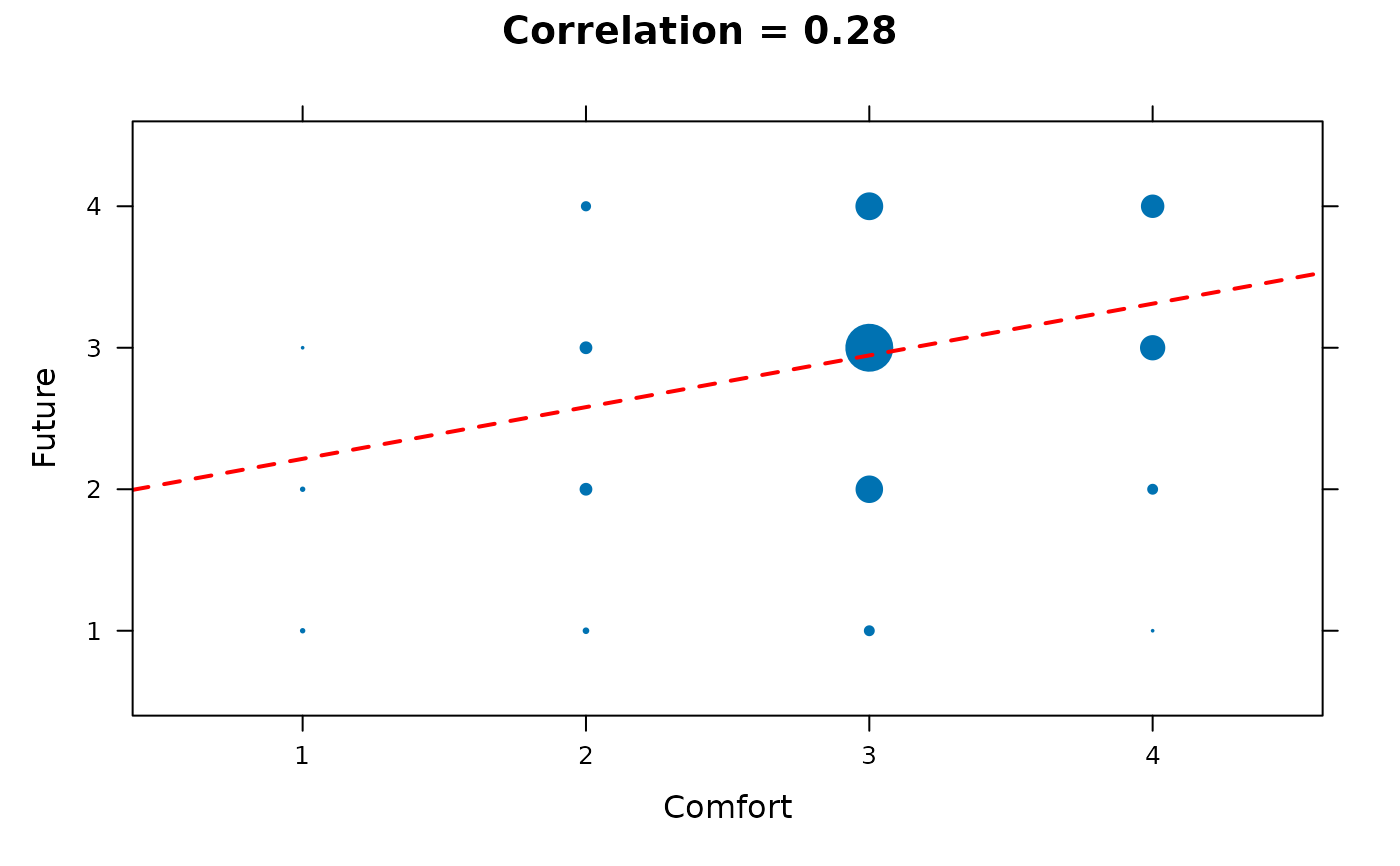 empirical_plot(Science, which.items = 1:4, type = 'prop')
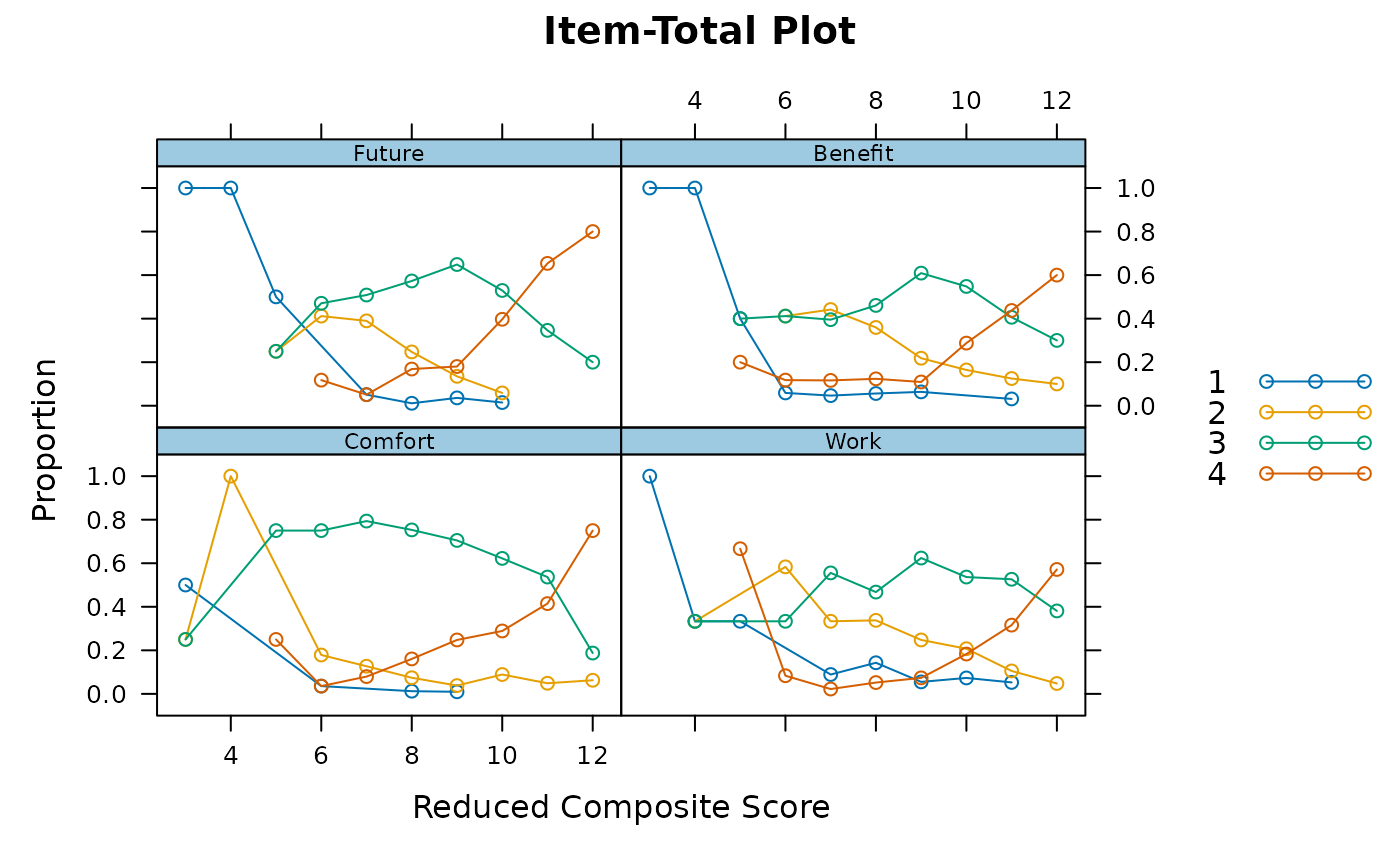 empirical_plot(Science, which.items = 1:4, type = 'prop', smooth=TRUE)
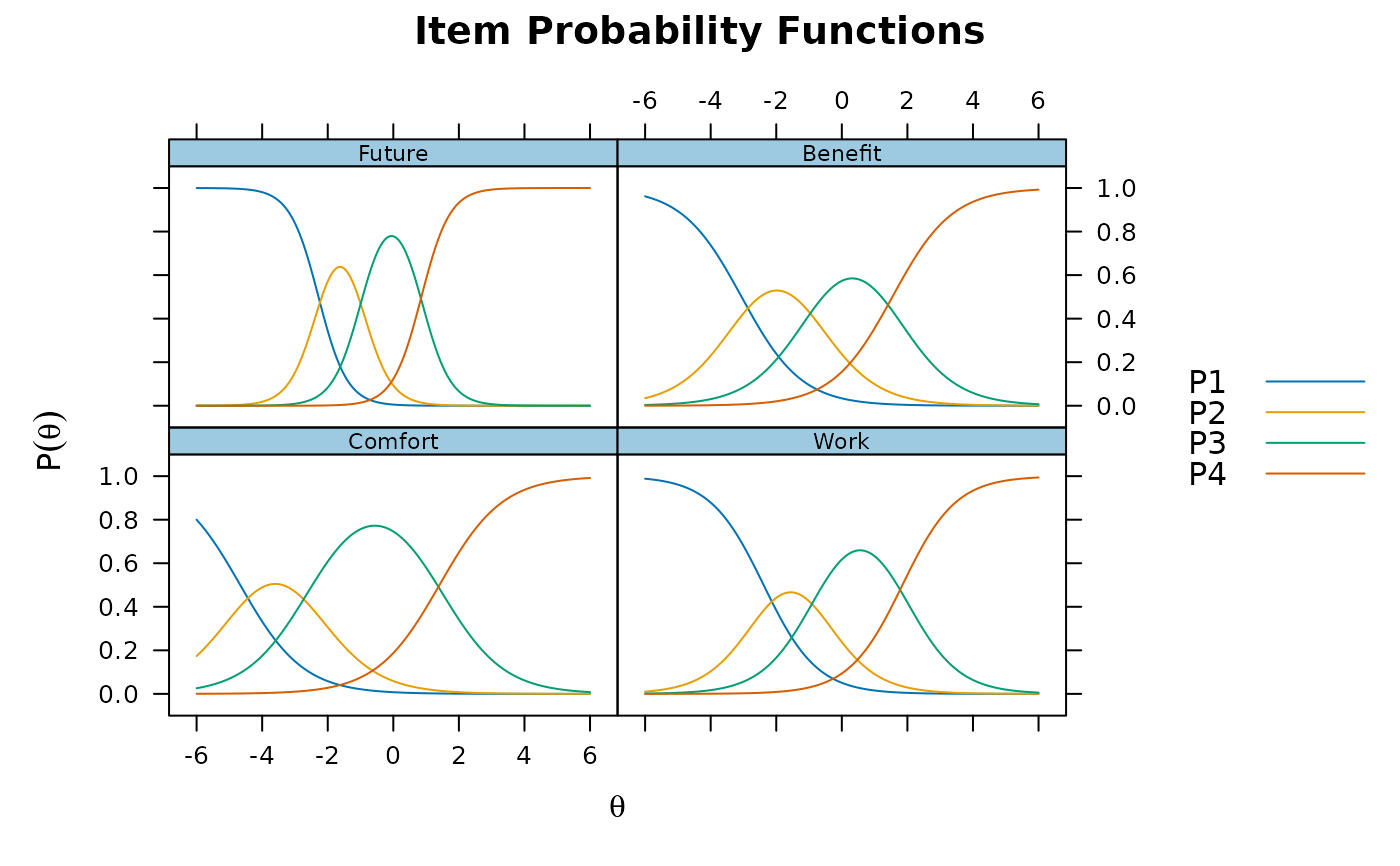
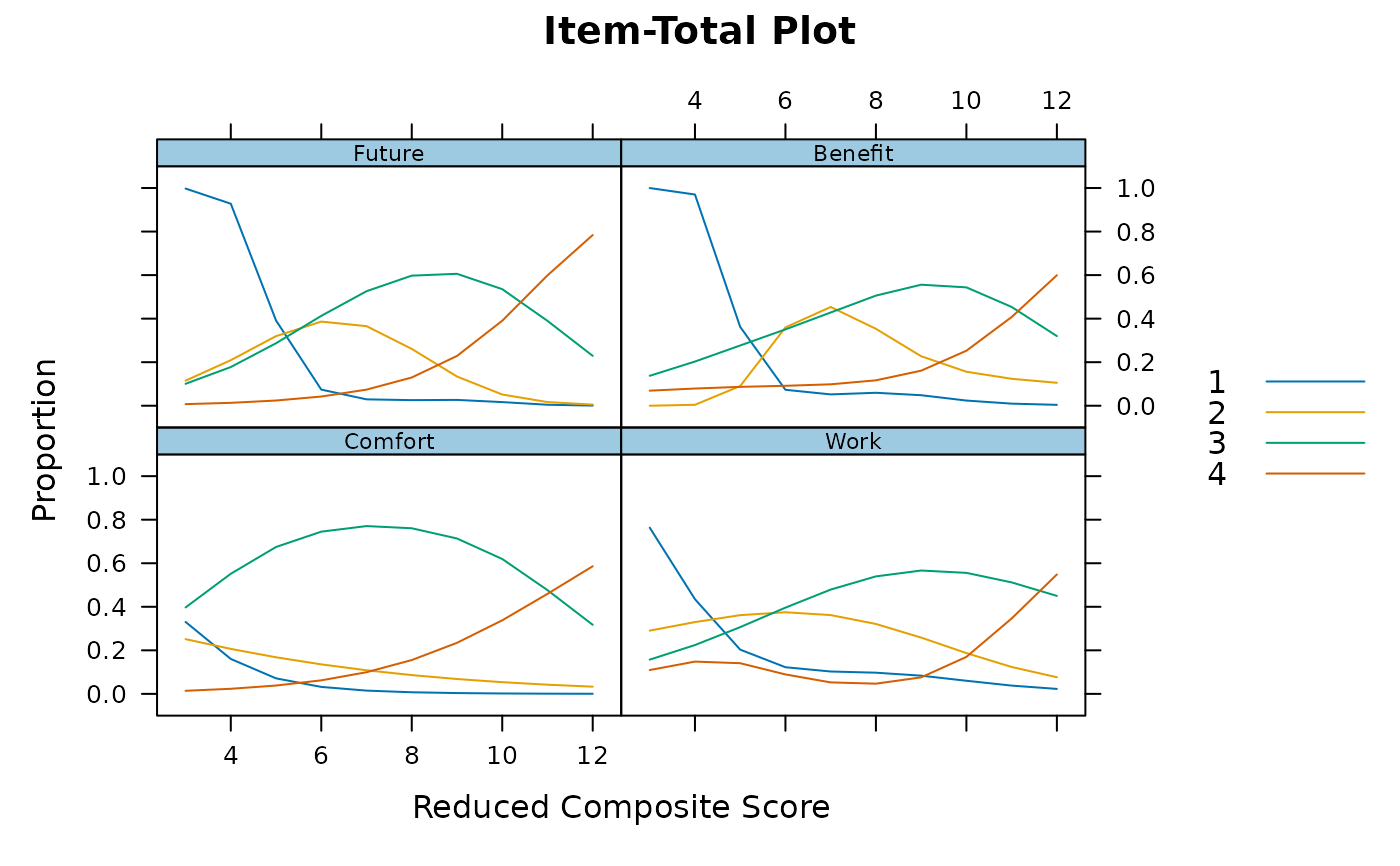 # last plot very similar to model-based approach (though conditioned
# on reduced total scores rather than scaled latent trait)
mod <- mirt(Science)
plot(mod, type='trace')
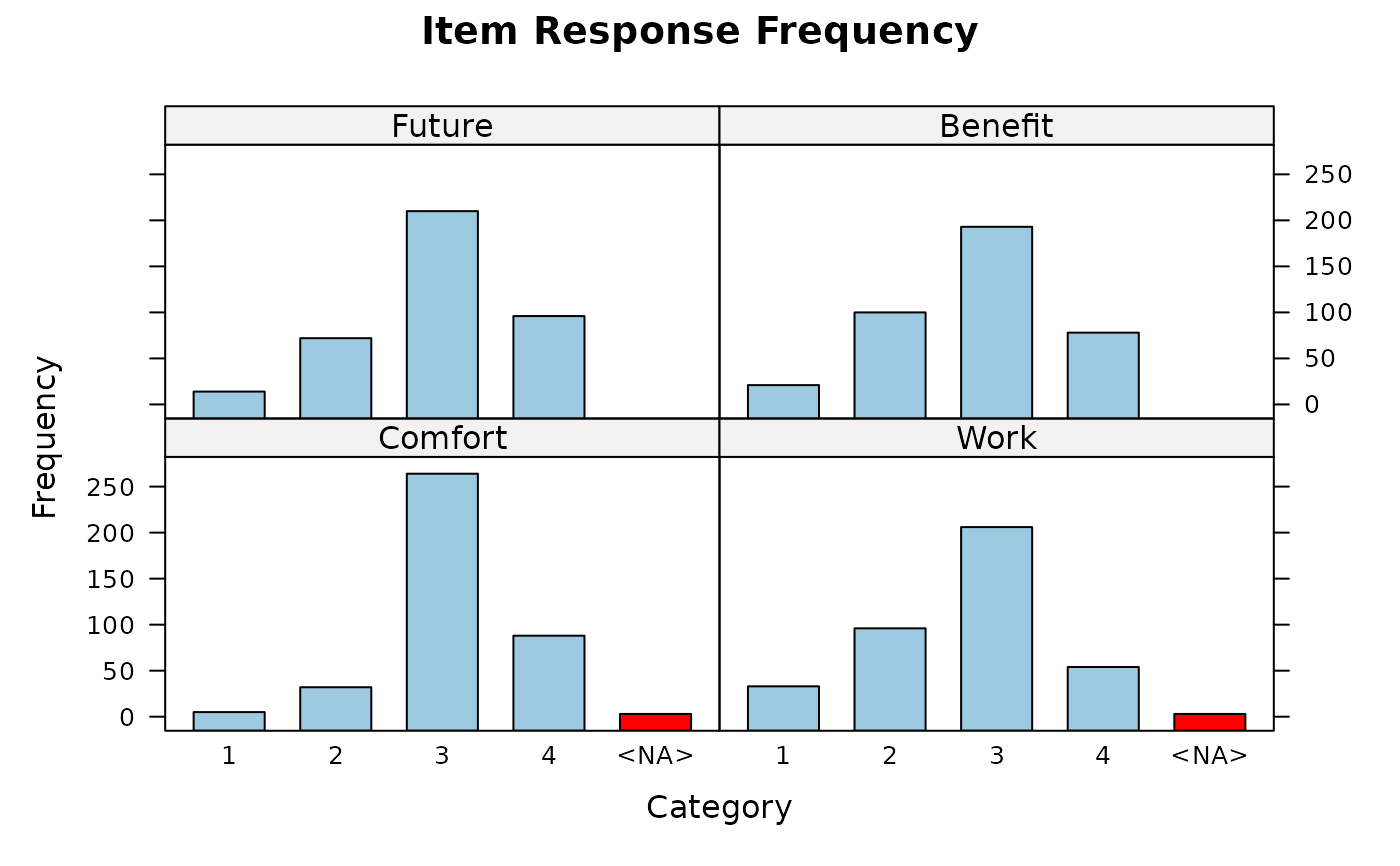
 # when missing values present
Science[1:3, 1] <- NA
Science[6:8, 2] <- NA
empirical_plot(Science, type = 'freq')
 # }